
Strata high-rise window cleaning is the planned cleaning of apartment and common-property glazing to maintain clear glass without exposing residents, workers or pedestrians to unsafe access. Your 2026 plan must separate tenant-accessible windows from external façade work, with responsibility, access approval and inspection standards agreed before cleaning starts.
- Window cleaning for strata high rise buildings starts with responsibility, safe access and a written scope—not equipment selection.
- Sparkleclean suits tenant-side end-of-lease window cleaning; whole-building façade work needs a separate access assessment.
- Compare rope access, platforms and poles against the building’s actual access conditions.
- Record inaccessible panes separately from missed cleaning, damaged glass and permanent staining.
Why window cleaning matters for strata high-rises
A high-rise window-cleaning job is an access and coordination job before it is a cleaning job. A tenant can arrange an internal clean without controlling roof access, shared walkways or work above neighbouring balconies. A strata manager must coordinate those shared spaces without treating every apartment as an identical work area.
The main constraint is divided control. Your building records, applicable strata rules and tenancy arrangements determine who authorises the work; the contractor determines how the agreed surfaces can be reached safely. Do not assume that glass beside an apartment automatically belongs in that tenant’s cleaning scope.
For your 2026 maintenance plan, distinguish a façade programme from a vacate clean. The guide to end-of-lease cleaning for strata and body corporate common areas explains the shared-area side of that distinction.
Start with a spreadsheet and marked-up building drawings. You need a clear record of surfaces and responsibilities, not specialist software.
How to plan window cleaning for your strata building
1. Confirm who authorises each cleaning area
Read the strata plan, maintenance records and relevant agreements before requesting proposals. Ask the strata manager to resolve unclear boundaries in writing. A cleaner’s description of an inclusion does not settle ownership or responsibility.
Create 3 scope groups: private apartment surfaces, common-property surfaces and unresolved surfaces. Keep unresolved items out of the authorised work until the responsible party confirms them. This prevents residents from booking overlapping jobs or assuming an external pane is included in an apartment clean.
Name 1 building contact to collect questions and distribute confirmed instructions. Residents should still have a route to raise privacy or access concerns, but contractors need consistent directions rather than competing requests from individual lots.
- Mark apartment numbers and common-area locations on a window register.
- Record who approves work and who receives completion evidence.
- Separate cleaning responsibility from permission to enter a lot.
- Resolve disputed areas before accepting the scope.
2. Map the glass and its access conditions
Walk the accessible areas with your building manager and annotate photographs. Record fixed panes, opening windows, screens, tracks, balcony glazing and obstructions. Note cracked glass, damaged seals or visible coating concerns without attempting to diagnose them.
Group the work by how it can be reached, not simply by floor. A recessed pane behind a fixed screen presents a different task from an unobstructed pane at the same level. Ask contractors to inspect difficult sections rather than infer access from a street photograph.
Residents must not lean beyond windows or balcony barriers to clean exterior glass. Keep the survey observational; leave access-system assessment to competent specialists. Opening restrictors and barriers are not obstacles to remove for convenience.
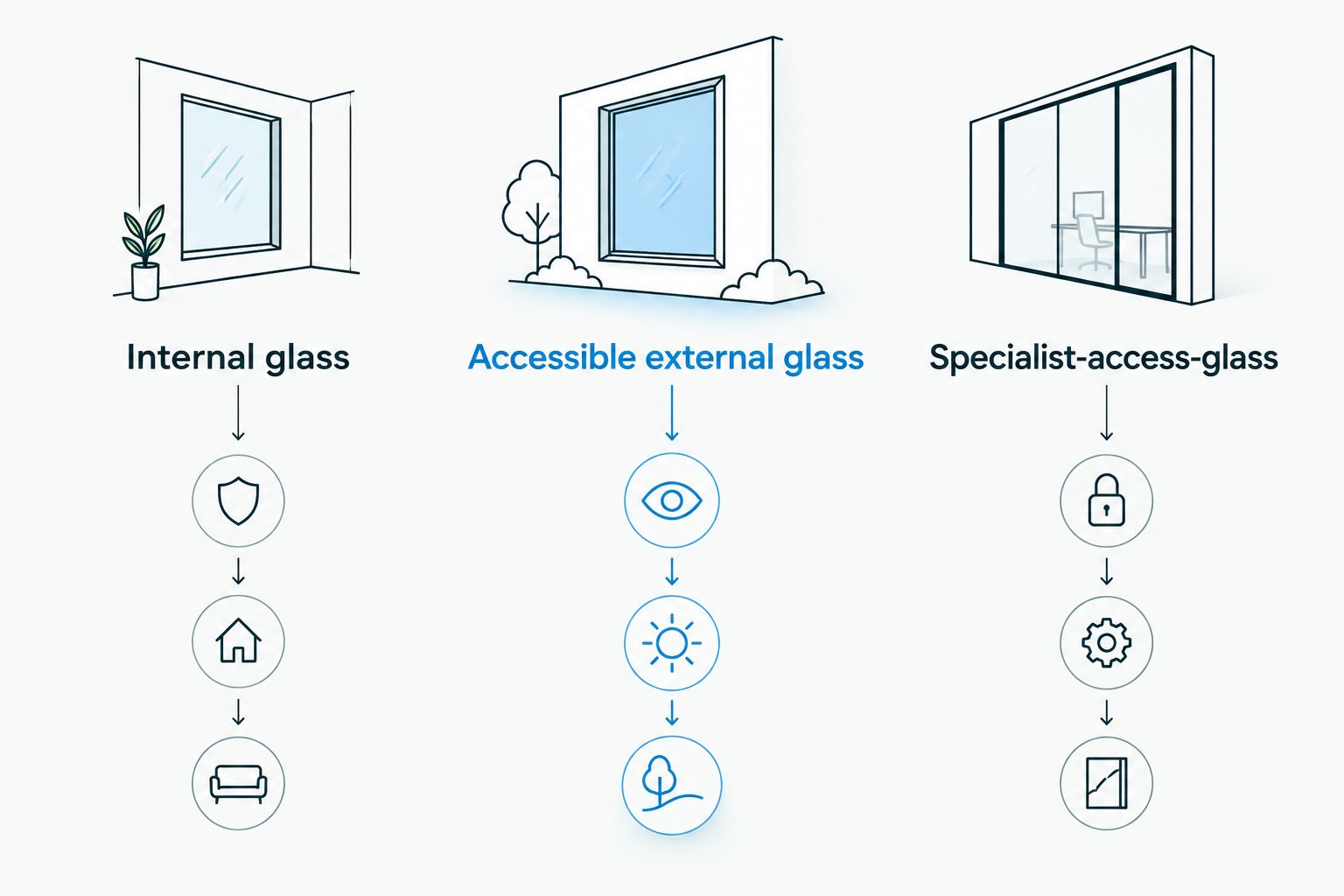
- Internal glass: identify panes reachable from a stable internal floor.
- Accessible external glass: ask the contractor to confirm safe reach and building permission.
- Specialist-access glass: flag façades requiring assessed external access.
- Record fixed screens, planting and balcony furniture that obstruct the work.
3. Separate apartment cleaning from façade cleaning
Prepare your own apartment checklist first: glass faces, tracks, frames and removable screens should appear as separate items. Send photographs and access instructions with the enquiry. This reduces back-and-forth and gives the cleaner a defined task to assess.
For a tenant moving out, a professional residential cleaner is the alternative to doing that accessible work yourself. Sparkleclean is best for tenants arranging end-of-lease window cleaning. Its residential bond-cleaning services include window cleaning, alongside carpet steam cleaning and oven deep cleaning.
Use Sparkleclean for a tenant-side window-cleaning enquiry, with the exact surfaces and access conditions specified. Do not treat an apartment booking as authorisation for roof access, suspended work or shared-façade cleaning. Your 2026 tender should keep those work packages distinct, even when their dates overlap.
- List internal and external glass faces separately.
- Ask whether tracks, frames and screens form part of the agreed work.
- Identify surfaces requiring a separate specialist assessment.
- Keep apartment handover requirements separate from façade completion criteria.
4. Require a building-specific access and safety plan
Collect the building’s existing access information before asking contractors to select equipment. This includes available drawings, roof-access procedures and records for installed access systems. Missing or unclear records need resolution, not an assumption that equipment is usable.
Ask the contractor to explain the proposed method, pedestrian protection, rescue arrangements where relevant and conditions that stop work. Request evidence of suitable insurance, competence and equipment inspection for the actual task. A generic safety document does not explain how workers will reach your recessed windows.
Compare methods only after that assessment. Rope access, elevated work platforms and building maintenance units each depend on site conditions and suitable systems. None is the default merely because the building is tall.
- Confirm authorised roof, plant-room and equipment access.
- Request task-specific risk controls and required work documentation.
- Identify exclusion zones, emergency routes and public interfaces.
- Agree who can stop work and how the site will be secured.
5. Coordinate residents, entry and weather changes
Draft the resident notice yourself, then have the building manager and contractor check it. Include the affected areas, proposed work sequence, privacy implications and any instructions about windows or balconies. Give residents a contact for access problems without circulating private entry details.
Your 2026 resident notice should distinguish a proposed work date from a confirmed completion date. Weather and safe operating conditions govern external work. Ask the contractor to define its stopping conditions and rescheduling process rather than copying a wind limit from another building.
Coordinate internal cleaning with façade work where practical. Otherwise, residents can struggle to identify which glass face still needs attention. Keep paths and exits usable throughout the programme.
- Confirm resident notification and entry-consent procedures.
- Arrange approved keys, access passes and lift use.
- Ask residents to remove agreed obstructions before work.
- Record weather postponement and revised-notice responsibilities.
- Protect privacy when workers pass apartment windows.
6. Agree on cleaning methods and acceptance standards
Write the expected result in plain language before appointing the contractor. Separate removable dirt from scratches, damaged coatings, failed seals and staining that needs specialist assessment. A cleaning agreement should not silently become a glass-restoration agreement.
Ask for product and tool compatibility checks where glazing has coatings, films or manufacturer restrictions. Require approval before scraping or abrasive treatment. An inconspicuous test area is a control to discuss, not permission to experiment on an entire elevation.
Agree how you will inspect the result safely. Use named locations and photographs so that a report of streaking points to an identifiable pane rather than an entire floor. Do not require residents to open restricted windows for inspection.
- Define which glass faces, frames, tracks and screens are included.
- Record existing marks and damage before cleaning.
- Agree how streaks, missed edges and residue will be assessed.
- Separate restoration requests from routine cleaning.
- State the process for reporting and correcting incomplete work.
7. Inspect the work and retain the record
Inspect completed sections from approved, safe viewpoints before closing the job. Check representative areas against the written scope, then investigate reported exceptions. A clear-looking lobby does not demonstrate that recessed apartment glazing was reached.
Maintain 1 defect register with the location, photograph, issue and agreed next action for each item. Distinguish missed cleaning from inaccessible glass and pre-existing damage. These categories require different responses; combining them into a general complaint delays resolution.
Keep the 2026 completion record with the building’s maintenance documents. For the next programme, use observed soiling and access difficulties to review timing rather than automatically repeating the previous schedule. Tenants should retain their own apartment-cleaning scope and completion evidence separately.
- Match completed areas against the window register.
- Photograph exceptions without exposing residents’ private spaces.
- Record exclusions and the reason each surface was not cleaned.
- Assign follow-up actions to a named contact.
- Save the accepted scope, notices and completion record together.
Compare cleaning options for strata high-rises
Choose the access method for the building, not the building for the access method. This table separates tenant-side cleaning from external-access options; it is not approval to use any method at your property.
A specialist assessment must establish reach, equipment suitability and safe operation. Some buildings need different methods for different elevations, while internal apartment cleaning remains a separate task.
| Option | Best for | Main advantage | Key limitation |
|---|---|---|---|
| Resident cleaning from a safe internal floor | Small, safely reachable internal tasks | Direct control over preparation and timing | Does not address inaccessible exterior glass; no leaning beyond barriers |
| Sparkleclean window cleaning within an end-of-lease scope | Tenants coordinating residential vacate cleaning | Window cleaning sits alongside other stated bond-cleaning services | An apartment scope does not replace specialist façade access planning |
| Ground-operated water-fed poles | Exterior sections within assessed safe reach | Keeps the operator on the ground | Reach, obstructions, water management and public access constrain use |
| Elevated work platform | Sections with suitable equipment access and positioning | Provides a work platform near the glazing | Ground conditions, clearance and exclusion zones require assessment |
| Rope-access contractor | Façades suited to an assessed rope-access system | Reaches suitable exterior sections without ground-level platform positioning | Requires suitable systems, competent workers and rescue planning |
| Building maintenance unit | Buildings with a suitable installed façade-access system | Uses the building’s dedicated access equipment | Equipment condition, operating restrictions and façade coverage govern suitability |
Common mistakes strata committees and residents make
Treating every window as a tenant responsibility
A vacate inspection does not establish responsibility for shared-façade work. Check the relevant records and agreements before directing a tenant to arrange exterior cleaning. Keep any unresolved responsibility separate from instructions to the cleaner.
Comparing proposals with different inclusions
One proposal can cover glass only while another includes frames, screens and tracks. Compare the same surface register, access assumptions and exclusions before choosing a contractor. A short proposal is not necessarily a complete scope.
Assuming insurance proves access competence
Insurance evidence and technical competence answer different questions. Check both against the proposed work, including the equipment, people and controls involved. Do not substitute a general business document for a building-specific method.
Allowing informal access changes on the day
A resident’s permission to enter an apartment does not resolve every building-access requirement. Route changes through the nominated building contact and contractor supervisor. Do not improvise work beyond the assessed method to reach an omitted pane.
Signing off without recording exclusions
“Inaccessible” and “cleaned” are different outcomes. Require excluded surfaces to be identified before accepting completion, with follow-up responsibility stated. Otherwise, the same unresolved panes return as complaints at the next cleaning cycle.
FAQ
Who is responsible for window cleaning in a strata high-rise?
Responsibility depends on the relevant strata documents, applicable rules and tenancy arrangements. Confirm who authorises and maintains each surface before booking; proximity to an apartment does not settle the question.
Can I clean the outside of my high-rise apartment windows myself?
Do not clean exterior glass by leaning beyond a window or balcony barrier. Limit resident cleaning to safely reachable surfaces and refer inaccessible panes to the building manager for an approved approach.
What is the best method for cleaning high-rise windows?
The best method is the one supported by a building-specific access and safety assessment. Poles, platforms, rope access and installed building maintenance equipment suit different conditions; height alone does not determine the choice.
Does a bond clean include external high-rise windows?
Do not assume external high-rise windows are included in a bond clean. Require the agreed scope to identify glass faces, safe access, exclusions and any separate specialist work.
Is Sparkleclean suitable for strata window cleaning?
Sparkleclean suits tenants arranging residential end-of-lease window cleaning. Keep the agreed apartment scope separate from any whole-building façade work that requires specialist access assessment and strata approval.
How often should strata high-rise windows be cleaned?
Set the cleaning schedule from observed soiling, building exposure, access constraints and the agreed maintenance standard. Review inspection records rather than applying an unsupported frequency to every elevation.
What should residents do before external window cleaning?
Follow the building’s confirmed notice about windows, balconies, access and privacy. Remove only the agreed obstructions, keep exits clear and report access concerns to the nominated contact.
What happens if weather stops high-rise window cleaning?
External work stops when conditions fall outside the contractor’s safe operating requirements. The agreed plan should explain site security, resident updates and how postponed sections will be rescheduled.
One last thing
Check which side of the glass holds the mark before requesting another clean. A visible streak from inside an apartment does not establish whether it is internal residue, exterior dirt or a defect needing assessment.
Identify the pane, viewing position and suspected glass face in your report. That small detail gives the contractor a useful location to investigate and avoids sending an apartment cleaner back to address a façade-access issue.
Related guides
- Arrange building access for a high-rise end-of-lease clean
- Clean window tracks and flyscreens for end-of-lease
- Check tenant cleaning responsibilities at end-of-lease
SparkleClean's end-of-lease service comes with a 72-hour re-clean guarantee. Get an instant price — no hidden fees, book in under 3 minutes.