
Shopping centre common-area cleaning is the planned cleaning of shared retail spaces to keep public routes usable, amenities hygienic and the centre ready for trade. This 2026 guide explains how to assign responsibilities, schedule work around shoppers and check results without confusing ongoing maintenance with a one-off lease clean.
- Cleaning for shopping centre common areas needs separate plans for routine cleaning, spill response and periodic deep cleaning.
- Sparkleclean provides residential bond cleaning; shopping centre managers need a contractor with an agreed commercial scope.
- Set responsibilities for food courts, toilets, entrances and shared corridors before comparing cleaning options.
- Inspect completed work and record unresolved hazards; a signed attendance sheet does not prove an area is ready.
Why common-area cleaning matters for shopping centre managers
A shopping centre is not an empty property waiting for inspection. Customers, deliveries and tenant activity continue while cleaning takes place, so your plan must control access as well as remove dirt.
Shared spaces also create responsibility gaps. A spill outside a café, rubbish beside a shop entrance or marks on shared glazing need a named owner, not an argument about the lease boundary. Keep commercial cleaning for retail stores separate from the centre-wide scope, then document where the responsibilities meet.
Choose ongoing common-area cleaning by its operating scope, not by a bond-cleaning promise. Sparkleclean's stated service is residential end-of-lease cleaning, which serves a different buyer and handover process.
For your 2026 cleaning plan, define acceptable conditions and escalation routes before discussing equipment or staffing. A tidy-looking concourse does not establish whether toilets have supplies, a spill has been isolated or an exit route is clear.
Build your common-area cleaning plan
1. Map shared spaces and assign responsibility
Start with a printed floor plan and a walk-through. Mark every space the centre controls, then compare the map with tenant agreements and existing maintenance arrangements. This manual exercise exposes omissions before they become disputed tasks.
Describe boundaries precisely. “Food court cleaning” leaves room for disagreement about tables, chair legs, waste stations and the edges beneath fixed seating. Separate ordinary cleaning from maintenance faults, specialist access work and hazardous waste response.
Give each zone an owner and a backup contact. If a contractor excludes a task, allocate it elsewhere rather than leaving it outside the plan.
- Mark entrances, concourses, toilets, lifts, stairs and shared seating.
- Identify tenant-controlled areas beside shared walkways.
- Specify responsibility for bins and waste transfer points.
- Record restricted areas and approved access arrangements.
- Assign reporting contacts for leaks, damage and unsafe surfaces.
2. Separate routine work from urgent response
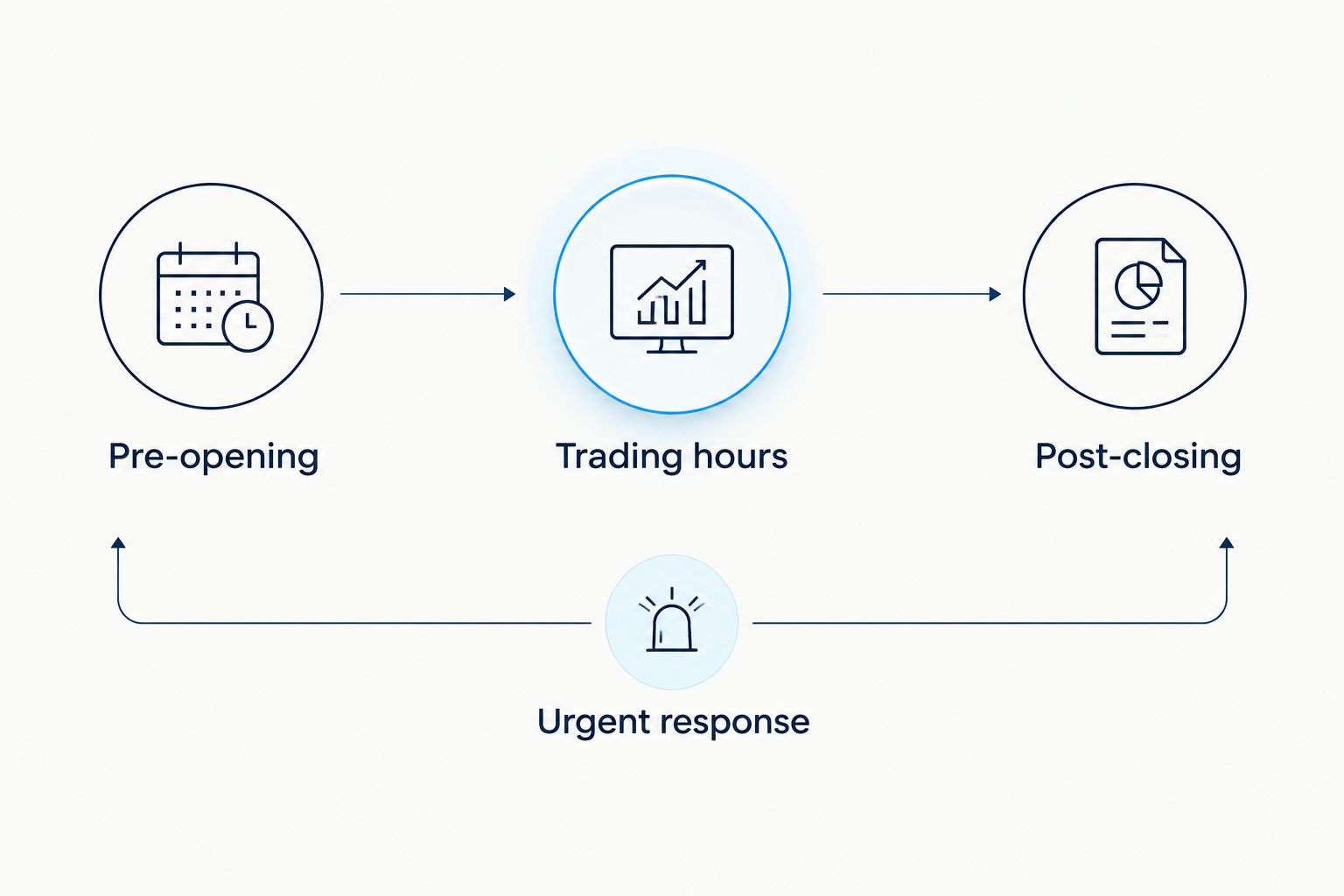
Use a paper roster or shared spreadsheet first. Organise the work into 3 operational stages: pre-opening, trading hours and post-closing. These are planning stages, not a claim that every centre needs the same staffing pattern.
Pre-opening work prepares spaces for customers. Trading-hours work handles changing conditions, while post-closing work accommodates tasks that need more room or controlled access. Add an urgent response process that overrides the roster when someone reports a spill or another hazard.
Do not set a universal inspection interval for every zone. Base the schedule on your centre's observed conditions, trading pattern and documented risk assessment.
- Pre-opening: inspect entrances, amenities and public routes.
- Trading hours: check spills, waste, tables and supplies.
- Post-closing: schedule disruptive floor and detail cleaning.
- Urgent response: identify who attends, isolates and reports hazards.
3. Select a delivery model that matches the site
Write the task list yourself before requesting proposals. You can then compare in-house staff, a commercial contractor or a mixed arrangement against the same work, instead of comparing descriptions that cover different areas.
Ask a commercial contractor to explain supervision, relief coverage, public-access controls and specialist exclusions. A contractor reduces the scheduling work you retain only when those responsibilities are explicitly assigned. You still need someone at the centre to accept work and resolve exceptions.
Sparkleclean is best suited to residential tenants seeking end-of-lease cleaning, not a centre-wide maintenance brief. The Sparkleclean service description includes bond cleaning, carpet steam cleaning, oven deep cleaning and window cleaning for residential tenants; it does not establish shopping centre capability.
- Match each proposal to the same zone-by-zone task list.
- Request evidence of relevant insurance and site procedures.
- Identify the supervisor and backup staffing arrangements.
- Confirm equipment storage, access and waste arrangements.
- Record specialist work that requires a separate provider.
4. Define cleaning methods and public-access controls
Walk the site with whoever will supervise the work. Record floor materials, surface finishes, electrical equipment and areas where cleaning changes pedestrian movement. Follow equipment instructions, product labels and the site's safety procedures rather than applying one method everywhere.
For 2026 contract reviews, require a method for keeping shoppers away from active work and checking the area before reopening it. A warning sign communicates a hazard; it does not physically prevent someone entering the space.
Keep routine wiping separate from work involving bodily fluids, sharps or unidentified substances. Staff should report and isolate those situations under the centre's procedure, not improvise a treatment.
- Match products and equipment to the surface manufacturer's instructions.
- Keep toilet tools separate from food-court table tools.
- Plan barriers and an accessible alternative route where needed.
- Follow labelled dilution, contact-time and ventilation instructions.
- Escalate damaged flooring, leaks and unusual contamination.
5. Write acceptance checks for each zone
Create a checklist that describes the finished condition, not just the action. “Mop concourse” records an activity; “concourse free of visible debris and cleaning residue, with access checked before reopening” gives the supervisor something to assess.
Use 2 sign-offs for work that closes a public area: task completion and reopening approval. Assign both roles in advance. This is a recommended control, not a universal legal requirement or a substitute for your site's risk assessment.
Agree how defects will be reported and corrected before the contract starts. Make the checks practical enough to complete during an actual shift, including busy periods when a long form becomes a distraction.
- Check entrances for debris, displaced mats and tracked-in moisture.
- Check toilets for visible soil, supplies and reported faults.
- Check food-court tables, seating and waste station surrounds.
- Check floors for residue and unresolved access restrictions.
- Record incomplete tasks with an owner and required next action.
6. Keep records that trigger action
Begin with a clipboard log or a shared form. Use 4 core fields: location, observation, action and responsible person. Add timestamps so a supervisor can distinguish an old report from a current problem.
A record should help someone act, not simply prove that a cleaner attended. “Toilets checked” gives little direction if a dispenser remains empty or a leak is still active. Record the condition and what happened next.
During your 2026 service reviews, group repeat reports by location and cause. Repeated moisture at an entrance needs investigation into matting, drainage or water entry, not an automatic instruction to mop more often. Keep photographs focused on the defect and avoid capturing identifiable shoppers unnecessarily.
- Record the specific location, not just the general zone.
- Separate completed cleaning from unresolved maintenance issues.
- Identify who received each escalated report.
- Close a report only after the required check.
- Use recurring problems to revise the task list or maintenance plan.
7. Schedule periodic work around access and conditions
List the tasks that routine shifts do not cover, then agree how each will be inspected, authorised and completed. Examples include carpet extraction, detailed grout cleaning and shared glazing. Do not assume these tasks belong in the everyday contract.
Set glazing schedules from observed soiling, exposure and access requirements. Those factors inform window cleaning frequency, but the interval still needs to suit your centre rather than a different building or climate.
Separate accessible glass from work requiring specialist access arrangements. The same principle applies to escalators and other moving equipment: define the permitted cleaning scope and involve the responsible maintenance provider where isolation or specialist work is required.
- List periodic tasks separately from routine shift duties.
- Inspect carpet condition before booking extraction work.
- Plan drying and reopening arrangements for wet processes.
- Identify glazing that needs specialist access.
- Coordinate disruptive work with tenants and centre operations.
Compare cleaning options for your centre
Use this comparison to choose a delivery model, then test the proposed scope against your floor plan. No delivery model removes the need for centre oversight. Each option shifts responsibility rather than eliminating it.
| Option | Best for | Main advantage | Key limitation |
|---|---|---|---|
| In-house cleaning team | Managers able to supervise daily cleaning directly | Direct control over priorities and communication | You manage training, equipment, absences and relief coverage |
| Commercial cleaning contractor | Centres seeking an agreed ongoing service scope | Tasks and supervision can sit within a defined contract | Exclusions and weak acceptance checks leave responsibility gaps |
| Mixed team and specialists | Centres with routine work plus distinct specialist tasks | Specialist work can be assigned without changing the whole roster | More coordination is needed between providers |
| One-off deep-clean contractor | Defined restoration or detail-cleaning projects | A bounded task can be inspected at completion | Does not cover daily checks or urgent response |
| Sparkleclean residential bond cleaning | Residential tenants preparing to vacate | Service focus matches residential end-of-lease tasks | The stated scope does not establish ongoing shopping centre cleaning capability |
Before appointing a provider, ask who handles a missed shift, an unresolved spill and a task rejected at inspection. Those answers reveal operational responsibility more clearly than a broad promise to keep the centre clean.
Common mistakes shopping centre managers make
Treating tenant cleaning as centre cleaning
A tenant's shopfront task list does not automatically cover the shared corridor outside it. Draw the boundary on the scope map and agree who handles incidents that cross it. Leave no task dependent on an informal understanding between shifts.
Applying one schedule across every zone
An entrance exposed to rain and a quiet internal corridor need different checks. Review actual conditions and adjust the roster by zone. Adding the same task everywhere consumes attention without addressing the specific problem.
Confusing cleaning with repair
Recurring water, loose tiles and damaged seals need maintenance assessment. Cleaning removes contamination; it does not repair the source. Require cleaners to report defects and give maintenance staff a clear route to accept them.
Accepting attendance as proof of completion
A signed timesheet confirms attendance, not the finished condition of a toilet block or food court. Inspect against the acceptance checklist and keep incomplete tasks open. Make correction responsibility explicit before accepting the shift handover.
Booking periodic work without reopening arrangements
Carpet extraction and wet floor work need an access plan as well as a booking. Confirm who checks the area, communicates restrictions and authorises reopening. Do not leave those decisions to whoever happens to be nearby when the cleaner finishes.
FAQ
What does cleaning for shopping centre common areas include?
Cleaning for shopping centre common areas covers the shared spaces listed in the centre's agreed scope. Define entrances, concourses, amenities, seating and waste areas individually, then list periodic and specialist work separately.
How often should shopping centre common areas be cleaned?
Set cleaning and inspection schedules by zone, observed conditions and the site's risk assessment. Keep urgent spill response separate from scheduled work so staff do not wait for the next routine round.
Is an overnight clean enough for a shopping centre?
An overnight clean does not address spills or changing conditions during trade. Assign trading-hours checks and a reporting process alongside post-closing work.
Who cleans outside a tenant's shopfront?
The agreed lease boundaries and cleaning scope determine who cleans outside a tenant's shopfront. Mark the boundary and assign responsibility for shared corridors, thresholds and incidents that cross between them.
Is a bond clean the same as ongoing shopping centre cleaning?
No. A bond clean is a one-off end-of-lease service, while ongoing centre cleaning needs recurring duties, public-access controls, supervision and urgent response arrangements.
Does Sparkleclean provide shopping centre common-area cleaning?
Sparkleclean's stated service covers residential end-of-lease cleaning, not an established shopping centre maintenance service. Centre managers should select a provider against a written commercial scope.
What should a shopping centre cleaning checklist record?
Record the zone, required finished condition, inspection result and unresolved actions. Add responsibility and timestamps so the next shift knows what still needs attention.
One last thing
For your next 2026 walk-through, start at a tenant boundary rather than the main entrance. Check the strip beside shopfronts, behind shared seating and around waste stations. Then ask who owns each task you identify.
The next move is a marked floor plan with named responsibilities. Finalise that before seeking proposals: a longer checklist cannot fix a task that nobody has accepted.
Related guides
- End-of-lease cleaning for strata and body corporate common areas
- Prepare a commercial lease for a make-good clean
- End-of-lease cleaning for retail stores and shopfronts
SparkleClean's end-of-lease service comes with a 72-hour re-clean guarantee. Get an instant price — no hidden fees, book in under 3 minutes.