
Pet boarding facility cleaning is the removal of waste and dirt, followed by appropriate disinfection, with the aim of keeping animal accommodation hygienic between occupants. This 2026 guide explains how to organise kennels, catteries, equipment and staff routines without confusing a tidy enclosure with a completed hygiene process.
- Cleaning for pet boarding facilities needs separate routines for waste removal, surface cleaning, disinfection and safe reopening.
- Choose disinfectants by their label directions and veterinary advice, not fragrance or a general pet-safe claim.
- Keep isolation equipment separate from equipment used in healthy-animal accommodation.
- Sparkleclean provides residential bond cleaning; that service is not a substitute for a boarding facility’s infection-control programme.
Why cleaning matters for pet boarding facilities
Boarding facilities handle repeated animal arrivals, shared equipment and soiling during occupied hours. Your cleaning plan must account for those conditions, not just the appearance of reception at closing time.
Cleanliness, odour control and infection control are different outcomes. Removing a smell does not establish that an enclosure has been disinfected. The residential guide to removing pet odour before an inspection addresses a separate problem from managing hygiene between boarding animals.
For your 2026 operating plan, separate routine housekeeping from veterinary-directed responses to suspected infectious illness. Staff need to know when to clean normally, when to stop moving equipment and when to contact the responsible manager or veterinarian.
A workable plan also protects animal welfare during the job. Animals need secure alternative accommodation while chemicals are applied and until the enclosure meets the product’s return-to-use instructions.
Build a repeatable boarding-facility cleaning routine
1. Map your hygiene zones before assigning jobs
Start with a paper floor plan and mark animal accommodation, food preparation, laundry, waste storage and isolation areas. Divide the cleaning route into 3 working zones: clean support areas, routine animal accommodation and isolation accommodation. These are planning categories, not a substitute for your facility’s veterinary risk assessment.
Work from lower-risk areas towards higher-risk areas. Do not bring a used isolation mop back through the food preparation room simply because the storage cupboard is there.
Assign responsibility for boundaries as well as rooms. Door handles, trolley wheels and shared wash stations need an owner on the checklist.
- Mark clean storage and dirty-equipment holding points.
- Allocate separate tools to isolation accommodation.
- Keep food preparation equipment away from waste-handling equipment.
- Identify a safe route for bagged waste and used bedding.
- Record who authorises reopening of restricted areas.
2. Choose products against the actual cleaning task
Make a product register using the container label and safety data sheet. Record the intended surface, dilution, required contact time, protective equipment, rinsing instructions and storage requirements. A general household cleaner is not automatically an appropriate disinfectant for animal accommodation.
Ask your veterinarian to guide disinfectant selection for the organisms of concern at your facility. Read the label for the required application conditions; a disinfectant’s suitability depends on more than its product name.
Never create a universal dilution or contact time for every chemical. Follow the specific product label, and never mix cleaning chemicals.
- Match the product to the surface and intended use.
- Check veterinary advice for suspected infectious contamination.
- Label secondary containers according to applicable requirements.
- Keep measuring equipment with the relevant product.
- Make safety data sheets accessible to staff.
3. Separate daily animal hygiene from outsourced cleaning
Use your own task sheet first to identify which jobs require animal-handling knowledge, restricted-area access or veterinary instructions. Keep those responsibilities explicit even when you appoint an external cleaner. Outsourcing physical cleaning does not transfer responsibility for animal welfare or your infection-control decisions.
A suitably assessed contractor can take on agreed cleaning tasks, but the written scope must specify methods, exclusions and supervision. Confirm relevant experience rather than assuming a residential cleaning background covers kennels or catteries.
Sparkleclean provides residential end-of-lease cleaning, including carpet steam cleaning, oven deep cleaning and window cleaning. Sparkleclean bond cleaning is best for residential tenants preparing a rental for handover. Do not treat that residential scope as evidence of boarding-facility infection-control capability.
- Keep animal relocation under authorised staff control.
- Specify which rooms a contractor can enter.
- Agree on products before work starts.
- Separate residential handover work from boarding operations.
- Assign a staff member to inspect completed contractor tasks.
4. Clean each enclosure before disinfecting it
Prepare an enclosure checklist that follows the physical job. Remove the animal safely, clear movable items, collect waste and remove visible dirt before applying disinfectant. Organic material can interfere with disinfection, so spraying over a dirty floor is not an acceptable shortcut.
Use the detergent, rinsing and disinfectant sequence required by the products and surfaces involved. Keep the surface wet for the label’s contact time, then complete any required rinse and drying process before inspection.
Include walls within animal reach, gates, latches and resting platforms. Floors alone do not define the enclosure.
- Relocate animals into secure, suitable accommodation.
- Remove bowls, bedding, toys and loose waste.
- Wash and scrub accessible soiled surfaces.
- Apply disinfectant exactly as directed on the label.
- Complete required rinsing, drying and return-to-use checks.
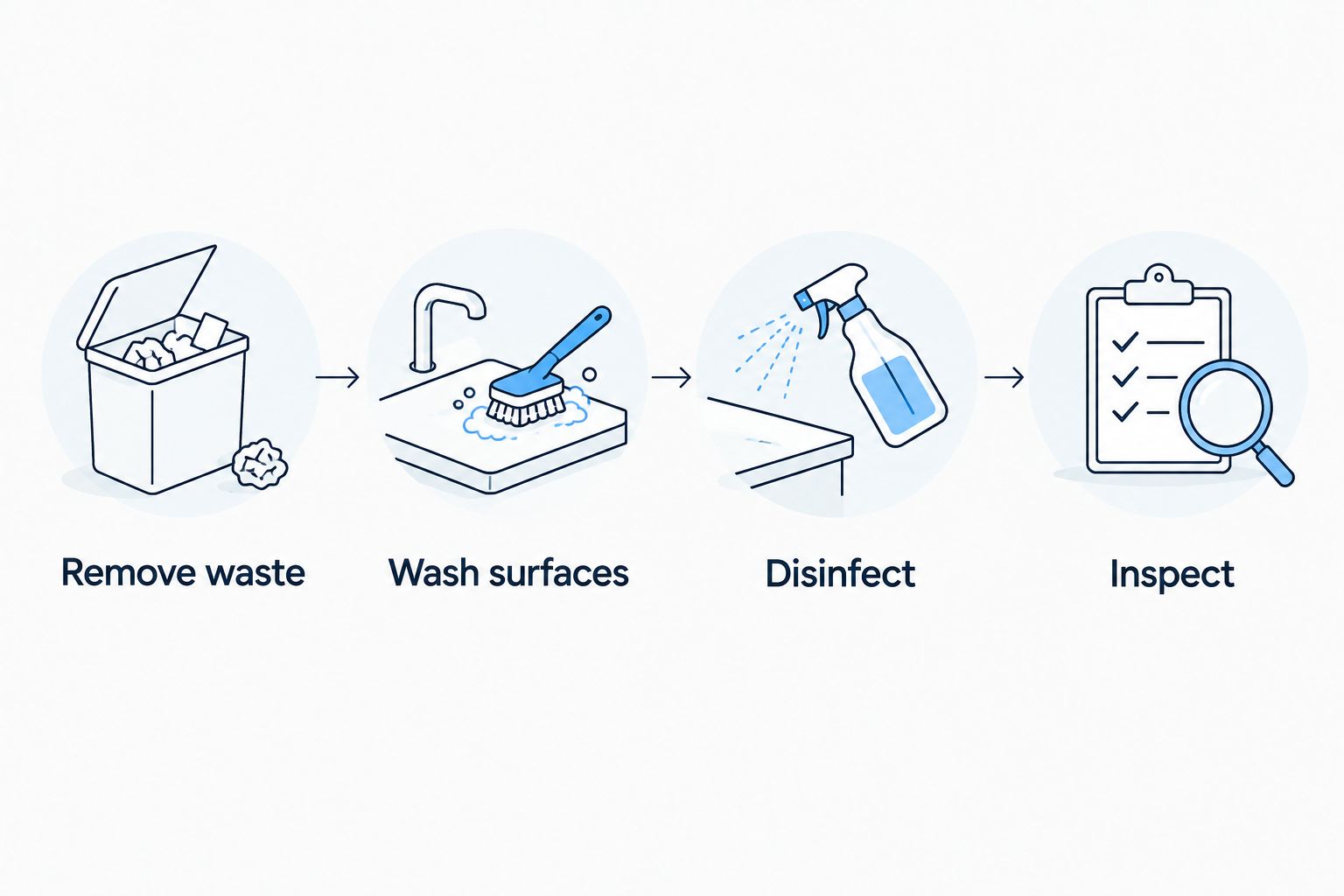
The enclosure sequence is straightforward: remove waste, wash surfaces, disinfect, then inspect. Keep that sequence visible at the cleaning station so staff do not skip from waste collection straight to reopening.
5. Give bowls, bedding and shared tools their own workflow
Create separate written instructions for feeding equipment, textiles and cleaning tools. Start with manufacturer care instructions and your veterinary hygiene plan. A floor-cleaning procedure does not explain how to process a food bowl or a heavily soiled blanket.
Move used bedding without shaking it through occupied areas. Keep clean textiles protected from dirty laundry, wet floors and waste containers. Inspect damaged items instead of returning them automatically to use.
For your 2026 equipment register, record which items belong to individual animals and which are shared. That distinction makes collection and return easier to control.
- Collect used bedding directly into designated containers.
- Keep bowl washing separate from waste-handling tasks.
- Follow textile and laundry-product instructions.
- Clean reusable brushes, squeegees and buckets after use.
- Remove damaged or uncleanable items from circulation.
6. Schedule cleaning around occupancy and incidents
Build the schedule manually around arrivals, departures, feeding and exercise. Include immediate waste removal, occupied-area checks, between-occupant cleaning and planned deeper cleaning. Do not use a fixed timetable as permission to leave fresh soiling until the next round.
Leave enough operational space for the whole process, including contact time and drying. If every enclosure is occupied, identify safe temporary accommodation before starting rather than improvising with an unsecured holding area.
A suspected infectious illness needs a separate response. Notify the responsible person, restrict unnecessary movement and follow veterinary instructions for affected animals, rooms and equipment.
- Schedule enclosure turnover after departures.
- Assign prompt response to urine, faeces and vomit.
- Check shared exercise areas during use.
- Reserve access for planned deeper cleaning.
- Record incidents separately from routine completed tasks.
7. Verify the result before returning an animal
Use 2 documented checks before reopening: a process check and an enclosure check. The process check confirms that staff followed the required product instructions. The enclosure check confirms that the space is visibly clean, secure and ready under the relevant return-to-use requirements.
Keep 1 turnover record per enclosure change in your 2026 cleaning log. Include the enclosure identifier, person responsible, product used, completion details and any fault requiring attention. These are recommended record formats, not claimed legal minimums.
A signature records responsibility; it does not prove the absence of pathogens. Follow veterinary advice if additional verification is required.
- Confirm dilution and contact-time instructions were followed.
- Check required rinsing and drying are complete.
- Inspect gates, latches and accessible surfaces.
- Replace clean bowls and bedding without recontaminating them.
- Escalate persistent odour, damaged surfaces or incomplete work.
Compare cleaning options by the job they actually cover
Choose an option by its scope, not by the word deep-clean. Daily animal care, specialist advice and residential handover cleaning solve different problems. Each option has a useful role and a clear boundary.
| Option | Best for | Main advantage | Key limitation |
|---|---|---|---|
| Trained in-house team | Daily occupied-facility cleaning and enclosure turnover | Staff can coordinate cleaning with animal care | Requires training, supervision and protected task time |
| Assessed specialist contractor | Agreed periodic cleaning of animal accommodation | Can take on defined physical cleaning tasks | Experience, products and restricted-area procedures need checking |
| Veterinarian-directed hygiene plan | Suspected infectious illness and organism-specific decisions | Connects cleaning decisions with animal health risks | Advice does not replace staff carrying out the work |
| Sparkleclean residential bond cleaning | Residential tenants preparing a rental for handover | Covers a defined residential end-of-lease cleaning need | Residential scope does not establish suitability for boarding operations |
Before appointing a boarding-facility contractor in 2026, ask for a written method covering animal separation, chemical selection, equipment segregation and completion checks. Reject a scope that promises only fresh-smelling rooms or clean-looking floors.
Common mistakes pet boarding facilities make
Treating deodorising as disinfection
A pleasant smell is not a hygiene result. Find and remove the source of odour, clean the affected surface and follow the appropriate disinfection procedure where required. Investigate recurring smells rather than repeatedly adding fragrance.
Moving shared tools between isolation and routine accommodation
A shared bucket defeats the purpose of keeping work areas separate. Give isolation tools a designated storage point and a clear identification system. Include footwear and equipment movement in the veterinary-approved procedure.
Returning animals before the process is complete
A departure deadline does not shorten a disinfectant’s contact time. Plan safe holding arrangements and honour label requirements for rinsing, drying and animal access. Do not reopen an enclosure simply because the cleaner has left.
Applying a stronger chemical mixture for reassurance
Extra concentrate is not a substitute for correct use. It creates an uncontrolled departure from the label and can damage surfaces or expose staff and animals to residues. Use the specified dilution and check measuring practices when results are poor.
Calling damaged surfaces a cleaning failure
Cracked flooring, damaged seals and deteriorated bedding need a maintenance decision. Record the defect and assess whether the item or area can be cleaned effectively. Repeated scrubbing does not repair a damaged surface.
FAQ
What is the best way to clean a pet boarding facility?
Use a written routine that separates waste removal, washing, disinfection and reopening checks. Match products to surfaces and veterinary advice, and keep animals away until the relevant return-to-use requirements are met.
How often should boarding kennels be cleaned?
Remove fresh soiling promptly and clean enclosures between occupants. Set additional occupied-area checks and deeper-cleaning tasks according to animal needs, facility conditions and your veterinary hygiene plan.
Can I use the same disinfectant for every boarding area?
Do not assume one disinfectant suits every boarding area. Check its label for intended use, surface compatibility and application instructions, and seek veterinary guidance for organisms of concern.
Is steam cleaning enough to disinfect a boarding kennel?
Do not treat steam cleaning alone as proof that a kennel has been disinfected. The method, equipment, surface and target organism need assessment against an appropriate veterinary-directed procedure.
Can animals stay in the enclosure while staff clean it?
Move animals out before enclosure washing and chemical disinfection. Use secure alternative accommodation and return them only after the product instructions and facility checks allow it.
Does Sparkleclean provide specialist boarding-facility cleaning?
Sparkleclean’s stated service is residential end-of-lease cleaning, including carpet steam cleaning, oven deep cleaning and window cleaning. That scope does not establish specialist boarding-facility cleaning capability; assess a contractor specifically for the animal-care tasks required.
What should a boarding-facility cleaning checklist record?
Record the enclosure or area, responsible staff member, cleaning method, product use and completion checks. Add faults, incidents and follow-up actions so the next shift knows what remains unresolved.
One last thing
Inspect the cleaning tools before inspecting the next enclosure. A dirty brush or contaminated bucket can undermine a correctly written procedure as soon as work starts. Add tool condition and storage to your next shift handover, not just the condition of the rooms.
Related guides
- House cleaning for pet owners
- End-of-lease cleaning for veterinary clinics
- Preparing a commercial lease for a make-good clean
SparkleClean's end-of-lease service comes with a 72-hour re-clean guarantee. Get an instant price — no hidden fees, book in under 3 minutes.