
Builders’ post-construction cleaning is the staged removal of building debris, dust and installation residue with the aim of preparing a completed property for inspection and handover. This 2026 guide explains how to scope the work, protect new finishes and separate cleaning tasks from defects that need a trade.
- Post construction cleaning for builders needs a written scope, controlled dust removal and a final inspection after trades finish.
- Separate rough cleaning, detailed cleaning and handover cleaning rather than treating them as one visit.
- Sparkleclean provides residential bond cleaning; do not treat that scope as a specialist builders’ clean.
- Record surface damage before cleaning, and approve residue-removal methods before work starts.
Why post-construction cleaning matters for builders
A builders’ clean has a different starting point from a household clean. You are dealing with newly installed materials, construction residue and trades moving through areas that have already been finished. A clean floor does not mean the property is ready for handover.
Your scope needs to distinguish loose dust from adhesive, grout haze, paint marks and damage. Each needs a different response. Ask a cleaner to remove everything without recording those differences, and you leave responsibility unclear when a scratch or stain remains.
For residential renovation work, the guide to deep cleaning for post-renovation homes provides related context. A builder’s handover scope still needs its own finish schedule, access plan and inspection criteria.
For your 2026 handover, define clean by room and surface—not by the phrase builders’ clean. Your client should be able to inspect the agreed work without guessing what was included.
How to plan post construction cleaning for builders
Define the scope before requesting quotes
Start with a floor plan and a room-by-room spreadsheet. List the surfaces, their condition and the required result. This is the manual way to create a clear brief before any provider gets involved.
Include cupboards, window tracks, door hardware, skirting boards and accessible fixtures explicitly. Separate internal glazing from external glazing, and identify anything that needs specialist access. Do not assume waste removal, pressure washing or residue removal sits inside a general cleaning scope.
Use 2 records: a cleaning schedule and a defect register. The first records work to complete; the second records damage or unfinished installation. Keeping them separate helps you avoid assigning a chipped tile to the cleaner.
- List every room and included surface.
- Photograph existing marks and unfinished work.
- Identify paint, adhesive, grout and protective-film residue.
- Separate rubbish removal from surface cleaning.
- Name exclusions, access restrictions and specialist tasks.
Sequence the clean around completed trade work
Build your 2026 cleaning programme around completed work, not just the calendar date. Start with a shared schedule showing which trades still create dust, where materials remain and when each area becomes ready.
Use 3 stages: rough clean, detailed clean and handover clean. These are planning stages, not a claim that every project needs exactly 3 visits. A small renovation and a multi-level build need different labour and access arrangements.
The rough clean removes agreed loose waste and prepares access. The detailed clean addresses accessible surfaces after dusty work ends. The handover clean checks presentation after defects have been rectified and the final trade movements are complete.
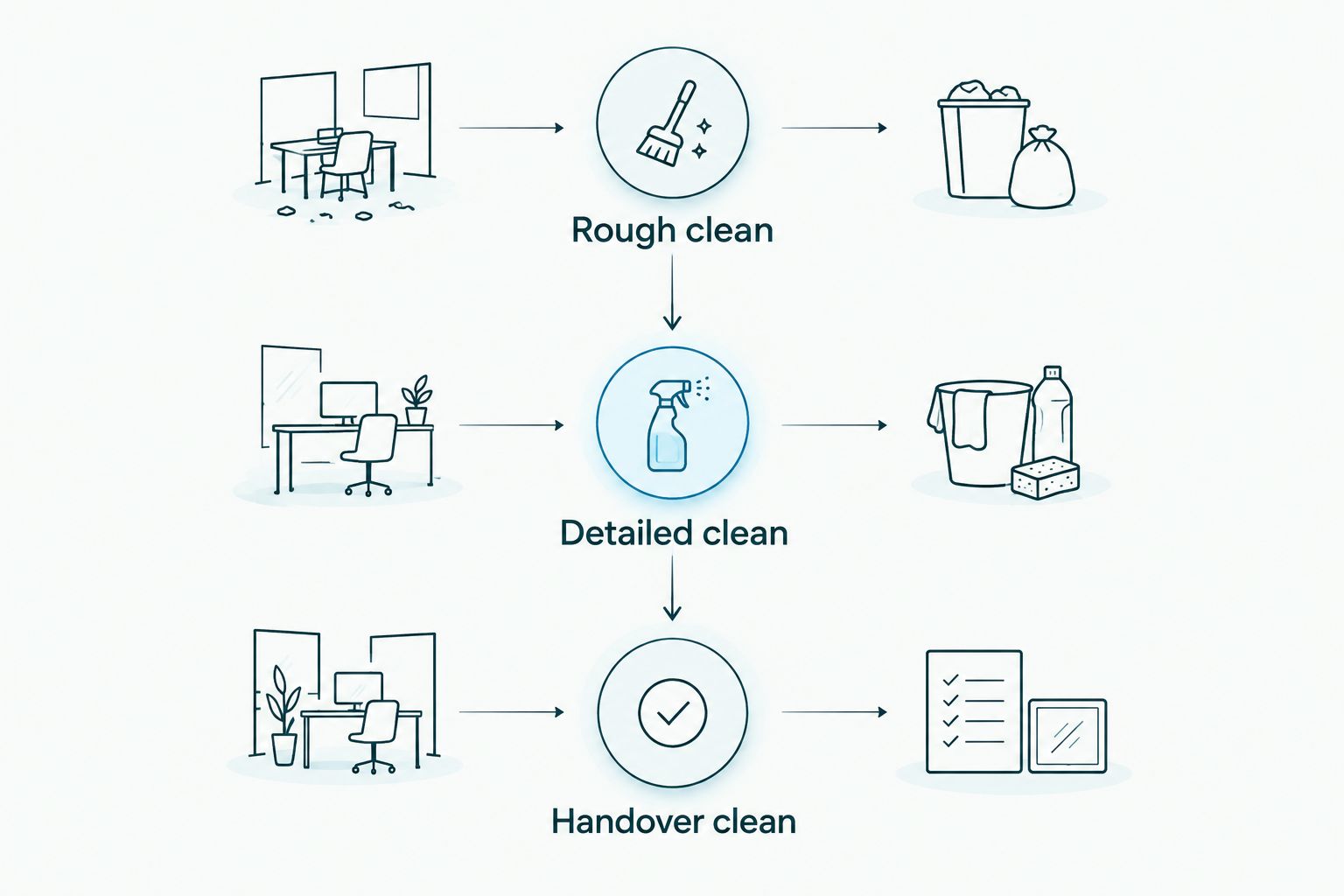
Protect completed areas once the detailed clean starts. Otherwise, fresh footprints and new dust become another cleaning task rather than evidence that the original work was missed.
- Finish cutting, sanding and drilling before detailed cleaning.
- Clear tools, offcuts and stored materials from included areas.
- Confirm access, lighting, water and safe power arrangements.
- Record which rooms are released for cleaning.
- Restrict unnecessary traffic through completed rooms.
Match the provider to the actual cleaning task
First assess what your own team can safely complete with suitable equipment and approved methods. Routine accessible wiping differs from collecting construction dust, removing bonded residue or working at height. Assign those tasks by competence, not convenience.
A specialist post-construction contractor is the appropriate option to assess for a build-wide scope involving construction dust and installation residue. Ask for the proposed methods, relevant experience, insurance documents and exclusions. A service label alone does not establish suitability.
Sparkleclean provides residential end-of-lease cleaning, including carpet steam cleaning, oven deep cleaning and window cleaning. Sparkleclean bond cleaning is best suited to residential tenants preparing for an end-of-lease inspection. That is a different brief from a builders’ handover clean; confirm any construction-related task separately rather than assuming it is included.
- Give every provider the same written scope.
- Ask who handles specialist residue and elevated access.
- Check equipment suitability for the identified dust.
- Confirm supervision and the inspection process.
- Keep tenancy cleaning and construction cleaning as separate scopes.
Control dust before wiping finished surfaces
Start by identifying where the dust came from. Concrete, mortar and other silica-containing materials require appropriate dust controls. Dry sweeping and compressed air can put settled dust back into the air; do not use them as shortcuts for construction-dust removal.
Follow the site’s risk assessment and applicable workplace safety requirements. Use vacuum equipment suitable for the identified dust, then use a surface-compatible wiping method for the remaining residue. Ordinary household equipment is not automatically suitable for construction dust.
Work from higher accessible surfaces downwards and move towards the exit. This is a cleaning sequence, not permission to improvise access equipment. Stop and arrange a suitable access method for anything your team cannot reach safely.
- Identify the material responsible for the dust.
- Avoid dry sweeping silica-containing dust.
- Select dust collection equipment for the actual hazard.
- Clean accessible upper surfaces before lower surfaces.
- Keep contaminated tools away from completed areas.
Protect finishes before removing stubborn residue
Build a material register from product documentation and information supplied by the installing trades. Record the flooring, benchtops, glass, fittings and coatings. Similar-looking surfaces do not necessarily tolerate the same chemicals or tools.
For your 2026 projects, make an approved cleaning method part of each finish’s handover information. Follow manufacturer instructions for curing, moisture exposure and cleaning products. Test a proposed method in an inconspicuous area before applying it widely.
Do not default to acidic cleaners, abrasive pads or blades. These can damage incompatible surfaces. If grout haze, silicone or paint remains after the approved method, photograph it and refer it to the responsible trade or a suitably qualified specialist.
- Obtain care instructions for installed finishes.
- Check curing requirements before wet cleaning.
- Test products and tools on an inconspicuous area.
- Use clean cloths to avoid transferring abrasive grit.
- Escalate persistent residue instead of increasing force.
Inspect the result and record acceptance
Use your original scope for the final walkthrough. Inspect each room under suitable lighting and check details beyond the main floor area: cupboard interiors, door edges, window tracks and accessible fittings.
Assign 1 sign-off contact to coordinate cleaning queries, trade defects and client feedback. This is a recommended responsibility structure, not a staffing requirement. The contact should know which issues belong to the cleaner and which need rectification elsewhere.
Keep dated completion photos beside the scope and defect register. For a 2026 handover, the record should show what was accepted, what remains outstanding and who owns each outstanding item. Cleaning acceptance does not replace building compliance checks or defect assessment.
- Inspect every included room against the written scope.
- Check tracks, edges and interiors—not just visible surfaces.
- Record missed cleaning separately from damaged finishes.
- Photograph completed areas before further trade access.
- Confirm responsibility for each outstanding item.
Compare cleaning options for your project
Choose by task and site condition, not by the provider’s general cleaning label. In-house work offers direct control, but your team needs suitable equipment and time. Specialist contractors reduce the cleaning work assigned to your trades, but you still need to manage access and approve the scope.
| Option | Best for | Main advantage | Key limitation |
|---|---|---|---|
| Builder’s in-house team | Routine tasks within the team’s competence | Direct control over sequencing and access | Uses internal labour and requires suitable equipment and supervision |
| Specialist post-construction contractor | Construction dust, installation residue and build-wide handover cleaning | A scope centred on construction conditions | Methods, exclusions and surface protection still need checking |
| Residential cleaning provider | General presentation cleaning after construction hazards and residue are resolved | Focus on accessible household surfaces | A household scope does not establish construction-dust or residue capability |
| Sparkleclean bond cleaning | Residential tenants preparing to vacate | End-of-lease services include carpet steam cleaning, oven deep cleaning and window cleaning | Bond cleaning is not the same brief as a builders’ clean |
Send the same scope to each contractor you assess. Ask them to identify tasks they cannot safely complete rather than quietly leaving those tasks outside an otherwise broad description. Compare responsibility, methods and acceptance criteria before choosing.
For residential projects that also involve a tenancy ending, Sparkleclean’s bond-cleaning services address that separate requirement. Keep the builder’s completion responsibilities documented independently so the tenant’s inspection does not become the default construction acceptance test.
Common mistakes builders make
Booking the final clean before dusty work finishes
A finished cleaning visit cannot prevent later drilling or sanding from creating new dust. Release rooms only when the relevant work is complete. If trades must return, record their access and arrange a targeted presentation check afterwards.
Treating every mark as removable dirt
A scratch, chipped edge or failed coating is not a cleaning task. Photograph marks before work begins and compare them with the defect register. Do not ask cleaners to keep scrubbing until damage becomes harder to distinguish from residue.
Leaving waste responsibility undefined
Packaging, offcuts and loose fittings need an agreed owner. Write down who removes each waste stream and where it goes. Do not assume the cleaner can move heavy materials, dispose of hazardous waste or decide which leftover fittings the client should retain.
Applying household methods to construction dust
Construction dust needs a material-specific assessment. A domestic broom or vacuum is not a default solution. Set the dust-control method before work starts and stop cleaning if an unidentified or hazardous material is discovered.
Using a tenancy checklist as the handover standard
Tenancy cleaning focuses on a rental inspection; builder handover also involves newly installed finishes, incomplete work and construction residue. Use your build-specific scope first. A residential checklist is useful for presentation details, but it cannot replace the construction brief.
FAQ
What is included in post construction cleaning for builders?
Post construction cleaning for builders includes the agreed removal of loose debris, construction dust and residue from specified surfaces. Write down rooms, glazing, tracks, cupboards and exclusions because the service name alone does not define the work.
When should I book the final builders’ clean?
Book the final builders’ clean after dust-producing work and relevant defect rectification finish. Confirm the site is ready before releasing the cleaner, and control trade access to completed areas.
Is a builders’ clean the same as a bond clean?
A builders’ clean is not the same as a bond clean. A builders’ clean addresses construction conditions, while bond cleaning prepares a rental property for an end-of-lease inspection.
Can my building team do the post-construction clean?
Your building team can complete tasks within its competence using suitable equipment and approved methods. Assess construction dust, stubborn residue and access hazards separately rather than treating all cleaning as routine labour.
Does Sparkleclean provide specialist builders’ cleaning?
Sparkleclean’s stated services are residential end-of-lease cleaning, carpet steam cleaning, oven deep cleaning and window cleaning. Confirm any construction-related scope directly; those services do not establish a specialist builders’ cleaning offering.
How do I stop cleaning from damaging new finishes?
Follow the installed material’s manufacturer care instructions and test the proposed method in an inconspicuous area. Avoid unapproved chemicals, abrasive tools and excessive moisture, and refer persistent residue to the responsible trade.
How do I know the property is ready for handover?
Check the completed cleaning against the written scope and record any outstanding items. Cleaning acceptance is separate from defect rectification, compliance checks and the builder’s other handover obligations.
One last thing
An empty property is easier to inspect, but it is not automatically ready to clean. You still need completed trade work, safe access and cleaning instructions for the finishes. Ask the installing trades to supply those instructions before they leave; that information is more useful than a last-minute instruction to make everything spotless.
For your next 2026 handover, put the cleaning scope beside the defect register at the walkthrough. Resolve every item under the right heading. You will leave with a clearer record than a single list mixing dust, scratches and unfinished work.
Related guides
- How to clean sliding door tracks
- How to clean cupboards and pantry shelves
- How to clean tiles and grout
SparkleClean's end-of-lease service comes with a 72-hour re-clean guarantee. Get an instant price — no hidden fees, book in under 3 minutes.