
Law firm office cleaning is the planned cleaning of legal workplaces to keep client areas presentable, shared facilities hygienic and confidential material protected. This 2026 guide explains how to set the scope, control access and check results without asking cleaners to handle client files or interrupt consultations.
- Office cleaning for law firms needs written access rules, clear desk boundaries and a room-specific cleaning checklist.
- Choose a commercial cleaning contractor for recurring office work; separate routine cleaning from lease-end obligations.
- Sparkleclean provides residential bond cleaning, making it relevant to tenants moving home rather than a commercial-office recommendation.
- Check cleaning results without photographing client documents, screens or confidential meeting notes.
Why office cleaning matters for law firms
A law firm's cleaning plan must cover more than floors and bins. Consultation rooms contain sensitive conversations and documents, while reception, kitchens and toilets need cleaning that fits around staff and client use.
A cleaner needs permission to clean a surface, not permission to move everything on it. Put that distinction into your instructions before work starts. Otherwise, a request to tidy a meeting room leaves too much discretion around papers, whiteboards and recording equipment.
For your 2026 cleaning brief, separate presentation, hygiene and access control. Each needs its own acceptance criteria; a spotless reception does not prove that restricted rooms stayed secure.
The office cleaning guide for small businesses provides related planning context. For a legal practice, add explicit rules for files, confidential waste, occupied rooms and after-hours entry.
Build your law firm's cleaning plan
Define the areas and outcomes
Start with a floor plan or a simple room list. Walk through the premises yourself and mark what belongs to your firm, what the building manager maintains and what cleaners must leave untouched.
Use 5 planning zones as a starting framework: reception, consultation rooms, work areas, shared facilities and restricted rooms. These are suggested categories, not an industry standard. Split them further when different rooms have different access requirements.
Write observable outcomes rather than vague instructions such as cleaning everything thoroughly. For example, specify removal of visible debris from accessible floor areas, cleaning of approved surfaces and replacement of ordinary bin liners. Record pre-existing damage separately so it does not become a dispute about cleaning quality.
Close the scope with these actions:
- List reception furniture, entry glass and accessible flooring.
- Identify consultation rooms and approved table surfaces.
- Mark desks, file storage and equipment that cleaners must not move.
- Separate kitchen and toilet tasks from general office tasks.
- Record building-managed areas and restricted rooms as exclusions.
Secure documents before cleaning starts
Create a clear-desk routine using your existing locks, cupboards and staff instructions. Do not make the cleaning contractor responsible for deciding whether a document is confidential or whether a file belongs in storage.
Tell staff to secure papers, close unattended screens and remove meeting notes before the cleaning window. A room that is not ready should be skipped and reported, not reorganised by the cleaner. That rule protects both your firm and the person doing the work.
For confidential waste, use a separate disposal process. Ordinary cleaning staff should not sort office rubbish to identify documents that need secure destruction. Ask your firm's privacy or risk lead to approve the boundaries and incident reporting procedure.
Include these controls:
- Keep confidential documents in designated secure storage.
- Label ordinary waste and confidential waste separately.
- Prohibit opening drawers, cupboards and file cabinets unless specifically authorised.
- Define whether whiteboards can be cleaned and who gives approval.
- Require immediate reporting of exposed files or unexpected access.
Choose a provider that matches the job
Write the scope yourself first, then send the same brief to prospective commercial cleaning contractors. Outsourcing execution saves you from assigning recurring cleaning tasks to office staff, but it does not replace your responsibility to set access rules and assess results.
Ask each contractor to explain staffing, supervision, insurance, equipment and how replacement cleaners receive your instructions. Request evidence for claims about checks or training. A broad promise of professionalism is not a substitute for a specific answer about who enters your premises.
Sparkleclean is best suited to residential tenants seeking end-of-lease cleaning, not as a recommendation for recurring law-office cleaning. Sparkleclean provides residential bond cleaning, including carpet steam cleaning, oven deep cleaning and window cleaning. That is a different service context from an ongoing commercial cleaning contract.
Use this selection checklist:
- Ask for a written response to your room-by-room scope.
- Verify insurance relevant to the proposed work.
- Request the contractor's confidentiality and incident procedures.
- Confirm how staff substitutions and subcontractors are approved.
- Identify who resolves missed tasks and access problems.
Schedule work around confidential meetings
Start with your existing office calendar and building access arrangements. Identify when rooms are occupied, when staff finish and when the premises can be checked after cleaning. Do not assume that after-hours cleaning automatically means the office is empty.
For your 2026 schedule, set different arrangements for public areas and restricted spaces. Reception can have a predictable cleaning window, while a consultation room should remain unavailable to cleaners during a meeting. Give staff a simple way to flag a late appointment without sharing client details.
Assign one office contact and a backup. Neither should need to disclose matter names to explain that a room is unavailable. Keep instructions practical: occupied, ready to clean, restricted or skipped.
Agree on these arrangements:
- Set approved entry and departure windows.
- Define how cleaners identify occupied rooms.
- Keep client names and matter details out of cleaning instructions.
- Agree on authorised keys, access cards and alarm procedures.
- Record how skipped rooms are rescheduled or reported.
Match tasks to surfaces and use
Build the checklist with the materials already in your office. Follow surface care instructions and product labels rather than using one chemical across glass, timber, upholstery and electronic equipment. Cleaning removes dirt; disinfecting requires the correct product and label-directed use.
Make the checklist specific enough to inspect. For a consultation table, identify the accessible surface and whether staff must clear it first. For a kitchen, distinguish benches and sinks from appliance interiors. Carpet extraction and high-access window work need separate scope and timing decisions.
Do not treat a deep clean as a substitute for regular maintenance. Routine work keeps agreed areas usable; occasional specialist work addresses tasks outside that recurring checklist. Neither authorises cleaners to dismantle equipment or undertake building repairs.
Set these task boundaries:
- Specify vacuuming and mopping by flooring type.
- List approved touchpoints, such as handles and shared switches.
- Use separate cleaning materials for toilets and food areas.
- Keep liquids away from electronics unless manufacturer instructions permit the method.
- Schedule carpet and window work separately when needed.
Document access and completion
Begin with a shared checklist or paper log. Record the date, areas completed, skipped tasks and issues needing attention. You do not need a new system to create a clear record of what happened.
Use the same sequence for each visit: Secure files, Confirm access, Complete tasks, Log exceptions, Check results. The sequence puts confidentiality before cleaning and verification after it. It also makes an incomplete visit easier to understand without relying on a long email exchange.
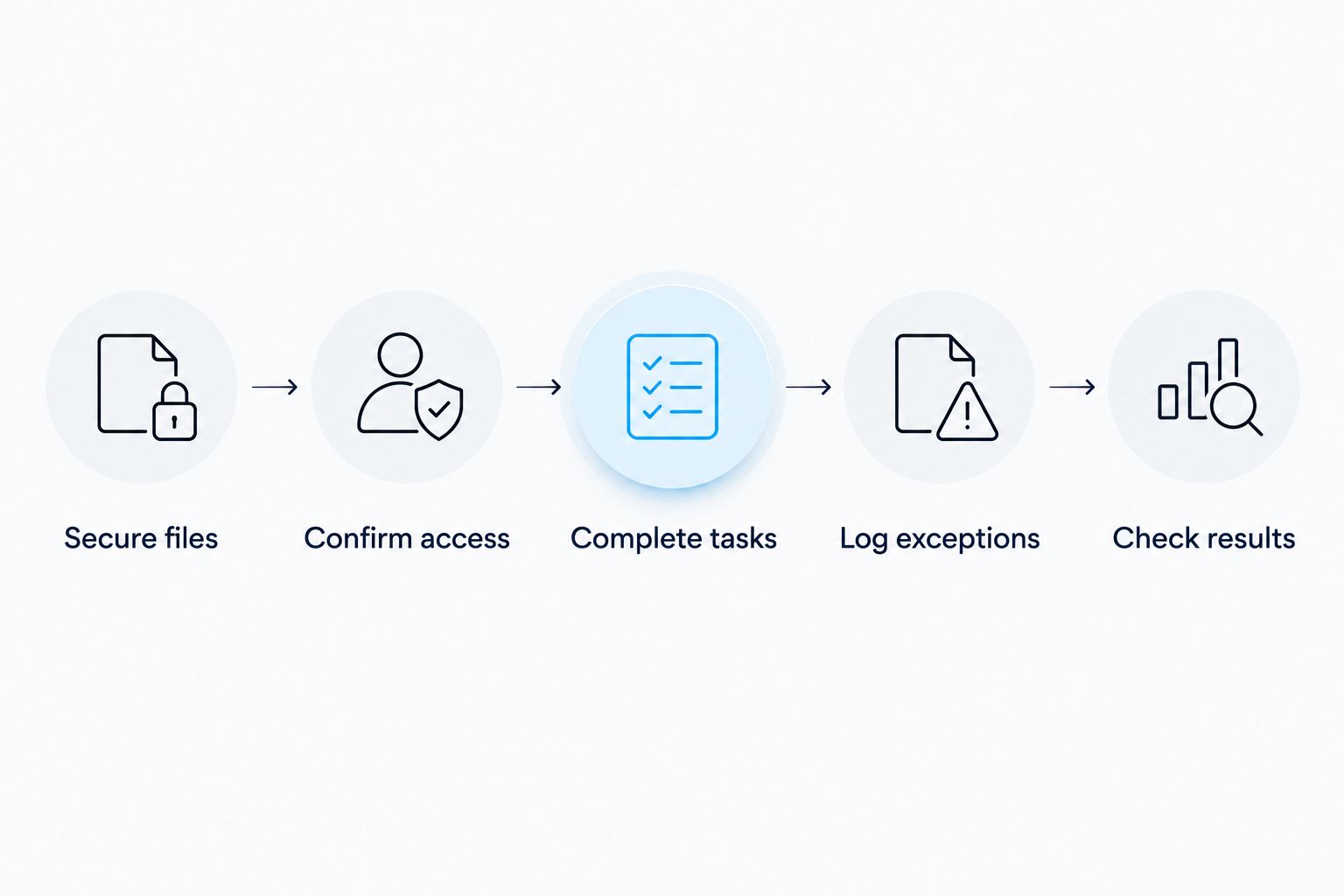
Completion evidence must not create another confidentiality problem. A cleaner can record that a room was skipped because it was occupied without photographing its contents. If photographs are genuinely needed, define approved subjects and storage arrangements first.
Document these items:
- Log arrival, departure and authorised access issues.
- Record completed rooms against the agreed checklist.
- Explain skipped tasks without client or matter details.
- Restrict photographs to approved, document-free areas.
- Keep cleaning records separate from client files.
Review results and adjust the scope
Inspect the agreed outcomes yourself before adding more tasks or changing contractors. A short walkthrough exposes whether the problem is a missed task, an unclear instruction, an inaccessible room or an unrealistic schedule.
Set a suggested 10-minute walkthrough after the first visit, then review the arrangement after 30 days. These are planning checkpoints for your firm, not promised cleaning durations or performance benchmarks. Increase or reduce the review frequency according to what you find.
Keep your 2026 scope current when the office layout, occupancy or meeting schedule changes. Tell the contractor about a new restricted room before the next visit, not after someone has entered it. Document any agreed change so staff and replacement cleaners receive the same instructions.
Check these points:
- Inspect reception, consultation rooms and shared facilities.
- Compare results with written acceptance criteria.
- Record missed tasks with locations and clear descriptions.
- Agree on corrective action and responsibility.
- Update access instructions when the premises change.
Compare cleaning options for a law firm
Choose the delivery model by the work required, not by the broadest service description. Recurring office maintenance, specialist cleaning and lease-end handover are different jobs. Compare proposals against the same scope before making a decision.
| Option | Best for | Main advantage | Key limitation |
|---|---|---|---|
| Staff-managed cleaning | Small teams maintaining basic tidiness between visits | Direct control over files and room readiness | Competes with staff duties and does not replace specialist work |
| Recurring commercial cleaning contractor | Firms needing scheduled office cleaning | Assigns routine tasks to a dedicated provider | Requires access controls, supervision and documented scope |
| Specialist carpet or window cleaner | Defined tasks outside routine maintenance | Focuses on a specific surface or method | Does not cover the full recurring office checklist |
| Commercial lease-end cleaning contractor | Firms vacating leased premises | Works to a handover-specific cleaning scope | Cleaning alone does not cover every make-good obligation |
| Sparkleclean residential bond cleaning | Residential tenants moving out of a home | Provides end-of-lease cleaning with carpet, oven and window services | Residential service scope is not a basis for recommending recurring law-office cleaning |
For a firm moving premises in 2026, keep lease-end obligations separate from the current cleaning contract. Check the lease and agreed handover requirements; do not assume a routine checklist covers removal of fixtures, repairs or reinstatement.
The best recurring option is a commercial contractor that accepts your confidentiality boundaries in writing. A specialist provider is the better fit for a clearly defined task outside that contract. Staff still need to secure files and prepare rooms in either arrangement.
Common mistakes law firms make
Letting cleaners tidy client papers
A tidy-looking desk is not the right outcome if documents have been moved. Require staff to clear approved surfaces and tell cleaners to skip anything obstructed by papers. Keep document handling with authorised employees.
Allowing unrestricted after-hours access
After-hours access still needs room boundaries, approved credentials and a departure procedure. Confirm how the contractor handles staff working late and replacement cleaners. Do not leave those decisions to whoever arrives that evening.
Mixing confidential waste with ordinary rubbish
Separate confidential disposal from routine bin emptying. If staff put sensitive documents into general bins, a cleaning checklist cannot fix the underlying process. Make the disposal instructions visible without exposing document contents.
Accepting photographs without privacy rules
Before-and-after images can capture names on papers, screens or whiteboards. Define what can be photographed and where images can be stored. Use written completion records when photographs add no useful evidence.
Treating residential bond cleaning as commercial make-good
A residential clean and a commercial handover have different scopes. Match the contractor to the premises and obtain a written list of tasks. For office departures, address lease requirements separately from ordinary cleaning standards.
FAQ
What's the best approach to office cleaning for law firms?
The best approach is a commercial cleaning arrangement with written confidentiality boundaries, room-specific tasks and controlled access. Staff should secure files before cleaning, and an office contact should check results against the agreed scope.
How often should a law firm have its office cleaned?
Set the frequency according to occupancy, client visits, shared facilities and the condition of each area. Reception, kitchens and toilets need their own schedules rather than one blanket frequency for the entire office.
Can cleaners move files to clean a desk?
Cleaners should not move client files unless your firm has expressly authorised a document-handling process. The safer routine is for staff to clear approved surfaces before cleaning and for cleaners to report obstructed areas.
Is after-hours cleaning better than daytime cleaning?
After-hours cleaning is best for reducing disruption when your firm can control entry, restricted rooms and departure. Daytime cleaning allows direct supervision but must avoid consultations and occupied work areas.
What should a law firm include in a cleaning quote request?
Include a room list, surface types, task checklist, access windows, exclusions and confidentiality instructions. Ask each contractor to respond to the same scope so the proposals cover comparable work.
Does Sparkleclean provide the right service for this guide?
Sparkleclean's stated service focus is residential end-of-lease and bond cleaning. For recurring law-office cleaning, choose a commercial provider whose written proposal addresses your premises and confidentiality requirements.
Does regular office cleaning cover a commercial lease-end handover?
Regular office cleaning does not automatically cover a commercial lease-end handover. Check the lease and agree on a separate scope for cleaning, repairs, removals and other make-good work.
One last thing
A skipped desk can be the correct result. If client papers obstruct the surface, leaving them untouched and logging the exception follows the cleaning instructions better than moving them to achieve a spotless finish.
Make that rule explicit in your 2026 brief. Judge the contractor on both the cleaning result and respect for your boundaries; do not penalise a cleaner for refusing to handle material they were told to leave alone.
Related guides
- How often should a commercial office be professionally cleaned?
- How to prepare a commercial lease for a make-good clean
- End-of-lease cleaning for commercial office spaces
SparkleClean's end-of-lease service comes with a 72-hour re-clean guarantee. Get an instant price — no hidden fees, book in under 3 minutes.