
No — a deep clean is not the same as a bond clean. A bond clean (also called an end-of-lease or vacate clean) is built to pass a landlord or real estate inspection and protect your bond refund. A deep clean is a thorough residential clean that goes well beyond a regular tidy, but it is not calibrated to Australian tenancy exit standards in 2026.
- A bond clean is not a deep clean — different purpose, different checklist.
- Bond cleans target landlord and agent inspection standards for bond return.
- Deep cleans go beyond regular house cleaning but skip tenancy-exit rules.
- Using only a deep clean before vacating is a common reason bonds get held in 2026.
- SparkleClean bond cleans are built for Australian end-of-lease inspections.
Why this matters
Tenants often book a deep clean thinking it will cover the exit inspection. Agents and landlords work from a different list. The gap shows up in ovens, carpet steam cleaning, window tracks, skirting boards and the condition report you signed at move-in. In 2026 that mismatch is still one of the fastest ways a bond gets docked.
If you are vacating a rental anywhere in Australia, the clean you need is the one written against tenancy exit standards — not a general deep clean sold for spring or post-party recovery. SparkleClean’s bond cleaning checklist for apartments in Australia maps the rooms and surfaces agents actually mark.
Is a deep clean the same as a bond clean?
No. The two services share some surface work, but they serve different buyers and different outcomes.
| Factor | Bond clean (end-of-lease) | Deep clean |
|---|---|---|
| Primary goal | Pass exit inspection, protect bond | Lift built-up dirt beyond regular cleaning |
| Checklist source | Lease, condition report, agent standards | Client preference or spring-clean brief |
| Carpet steam clean | Often required or strongly expected | Optional add-on |
| Oven and rangehood | Full strip and degrease standard | Usually included, not inspection-graded |
| Window tracks, flyscreens, skirting | Explicitly checked | Often skipped or light-touch |
| Proof / guarantee | Bond-back or re-clean terms common | Rarely tied to a landlord outcome |
| Best for | Tenants vacating a rental | Owner-occupiers or tenants mid-lease |
Best for tenants vacating: a bond clean. Best for a lived-in home that needs a reset: a deep clean. Mixing them up is the expensive mistake.
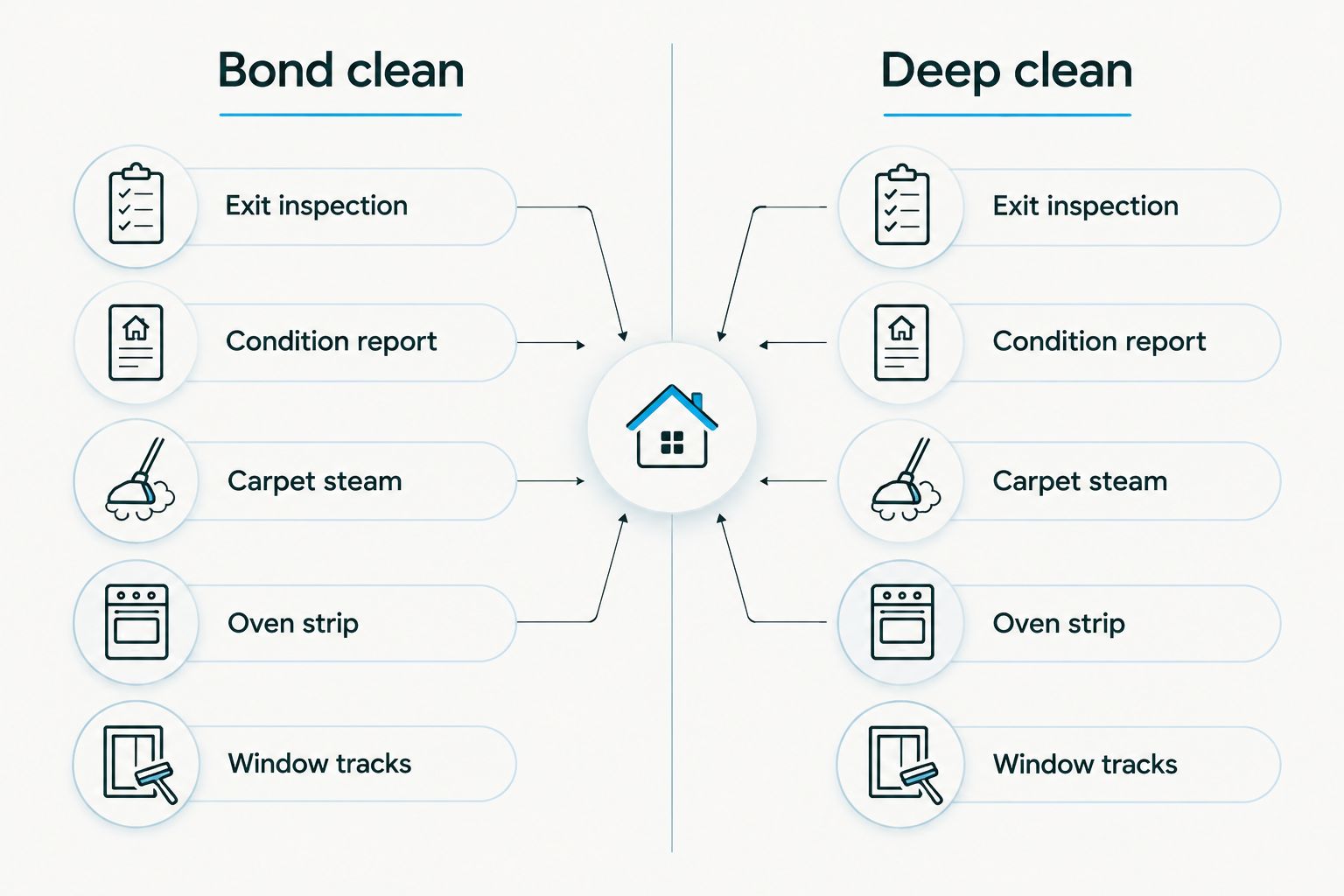
Bond clean: built for the inspection
A bond clean is an end-of-lease service. Cleaners work from the rooms and fixtures agents photograph and tick: kitchen (oven, cooktop, rangehood, cupboards inside and out), bathrooms (grout, exhaust fans, shower screens), bedrooms and living areas (skirting, switches, light fittings), windows and tracks, and often a carpet steam clean where the lease or agent requires it.
The standard is “as close as reasonable to the condition report,” allowing for fair wear and tear. That is a legal and commercial bar, not a preference. In 2026 most professional bond cleans also carry a re-clean window so failed items get fixed without another full fee.
Verdict: book a bond clean when you are handing keys back and want the bond released.
Deep clean: thorough but general
A deep clean is a heavy residential clean. It typically covers skirting, behind furniture, inside cupboards, detailed bathroom work and a strong kitchen degrease. It is the right job after a long stretch without a clean, before guests, or after renovations when dust sits in every corner.
It is not written against a tenancy condition report. Window tracks, flyscreens, ceiling fans, exhaust filters and full oven strip-downs are often lighter or left out unless you specify them. There is no bond-back frame and no agent checklist driving the scope.
Verdict: book a deep clean when you own the place or you are staying put and want a full reset — not when you are vacating.
Spring cleans, move-in cleans and “vacate-style” deep cleans
Other labels sit nearby and confuse the picture further:
- Spring clean — seasonal deep clean for owner-occupiers. Same limits as a deep clean for bond purposes.
- Move-in clean — prepares an empty property for new occupants. Useful for landlords between tenancies; not a substitute for the outgoing tenant’s bond clean obligations.
- “Vacate-style” deep clean — marketing language some general cleaners use. Unless the quote lists bond-grade items (oven strip, carpet steam, tracks, condition-report alignment) and a re-clean path, treat it as a deep clean.
Best for: owner-occupiers and mid-lease tenants (spring/deep); landlords between tenants (move-in); outgoing tenants (true bond clean only).
Why bond cleans and deep cleans diverge
The split is not branding fluff. It comes from how the work is scoped and judged.
- Who signs off. A deep clean is signed off by you. A bond clean is judged by the agent or landlord against the entry condition report.
- Legal frame. Australian residential tenancy rules in every state and territory expect the property returned in a reasonably clean state, fair wear and tear aside. Agents translate that into room-by-room lists. Deep cleans ignore those lists.
- Carpet steam cleaning. Many leases and agent checklists expect professional carpet steam cleaning at exit. Deep cleans treat carpets as optional.
- Kitchen appliances. Bond cleans strip ovens, rangehoods and often dishwashers to inspection grade. Deep cleans often wipe and degrease without a full strip.
- Hidden surfaces. Tracks, flyscreens, skirting edges, light fittings and exhaust fans drive bond deductions. Deep cleans routinely under-serve them.
- Remedy path. Bond-focused cleaners build in a re-clean window after inspection feedback. General deep-clean jobs rarely do.
For a plain view of what agents mark, see what landlords check during a bond inspection in Australia.
Can I use a deep clean instead of a bond clean?
You can book one — it often fails the inspection. A deep clean without bond-grade scope leaves the exact items agents flag: oven interior, carpet condition, window tracks and skirting. In 2026 that still translates into bond claims, re-clean call-outs and delayed refunds. If your goal is the bond, book a bond clean and get the checklist in writing before the team arrives.
What does a bond clean include that a deep clean often skips?
Bond cleans typically add inspection-grade oven strip-downs, carpet steam cleaning, window tracks and flyscreens, full skirting and switch detail, and a re-clean path tied to agent feedback. Deep cleans may touch some of those surfaces lightly, but they are not held to the condition report. Ask for a written room list before you pay a deposit on either service.
Do landlords accept a deep clean for bond return in 2026?
Only if the result matches the exit standard — the label on the invoice does not decide it. Landlords and agents assess the property, not the product name. A deep clean that happens to hit every bond item can pass; most do not, because the brief never named those items. In 2026 the safer path is a cleaner who works to bond checklists and offers a re-clean guarantee.
Book a bond-grade exit clean
Checklist-led end-of-lease cleans built for Australian inspections.
How to choose the right clean in 2026
Use the outcome, not the brochure line.
- You are vacating a rental. Book a bond / end-of-lease clean. Confirm carpet steam, oven strip, windows and a re-clean window on the quote.
- You own the home or you are staying. A deep clean or spring clean is the right fit.
- You are a landlord between tenants. A move-in or bond-grade clean between leases resets the property for the next condition report.
- You already booked a deep clean before vacating. Compare the quote line-by-line to a proper bond checklist. Add missing items or rebook before inspection day.
SparkleClean focuses on professional end-of-lease and bond cleaning for residential tenants across major Australian cities — carpet steam cleaning, oven deep cleaning and window cleaning included — with a 99% bond return rate, a 72-hour re-clean guarantee and a 4.9-star rating as the proof points tenants use when the bond is on the line.
Quotable rule: if the clean is not written against the condition report and agent checklist, it is not a bond clean — whatever the invoice says.
“If the clean is not written against the condition report and agent checklist, it is not a bond clean — whatever the invoice says.”
FAQ
Is a deep clean the same as a bond clean?
No. A bond clean is built to pass an end-of-lease inspection and protect your bond. A deep clean is a thorough home clean that is not calibrated to tenancy exit standards.
Will a deep clean get my bond back in 2026?
Only if it happens to meet every item on the agent’s exit list. Most deep cleans skip tracks, full oven strips and carpet steam cleaning, which are common bond claim points.
What is included in a bond clean that a deep clean misses?
Bond cleans typically cover inspection-grade oven and rangehood strip-downs, carpet steam cleaning, window tracks, flyscreens, detailed skirting and a re-clean path after agent feedback.
Is end-of-lease cleaning the same as bond cleaning?
Yes. End-of-lease cleaning, vacate cleaning and bond cleaning are the same service category in Australia — a clean scoped to the exit inspection.
Can I DIY a bond clean instead of hiring someone?
You can, if you match the condition report room by room and allow drying time for carpets. Many tenants still fail on ovens, grout and tracks without pro equipment.
Do I need carpet steam cleaning for a bond clean?
Often yes. Many leases and agents expect professional carpet steam cleaning at exit. Confirm it on your quote before booking.
How is a spring clean different from a bond clean?
A spring clean is a seasonal deep clean for people staying in the home. It is not written against a tenancy condition report or agent exit checklist.
What happens if my bond clean fails the inspection?
A cleaner with a re-clean guarantee returns to fix listed items inside the stated window. Without that term you pay again or risk a bond claim.
One last thing
The invoice title is the least useful signal on inspection day. Agents photograph ovens, tracks and carpet edges — not your booking confirmation. In 2026 the tenants who keep their full bond are the ones who matched the clean to the condition report, not the ones who booked the deepest-sounding package. If a quote cannot show a bond checklist and a re-clean path, it is a deep clean wearing different clothes.
Related guides
- What is included in a bond clean in New South Wales
- Professional bond cleaning vs DIY in Australia
- End-of-lease cleaning checklist for renters in Australia
- Best deep cleaning services in Australia
SparkleClean's end-of-lease service comes with a 72-hour re-clean guarantee. Get an instant price — no hidden fees, book in under 3 minutes.