
A bond clean is not the same as a regular house clean. A regular clean tidies visible surfaces for everyday living — benches, floors, bathrooms — while a bond clean scrubs the property to the exact checklist standard a property manager checks against the entry condition report. That standard covers zones a weekly clean skips entirely: inside ovens, exhaust fans, window tracks, skirting boards, and every wall mark left by furniture or Blu Tack.
Skip those hidden zones and the house can look spotless to the eye and still fail inspection. That's the gap between a house clean and a bond clean, and it's the gap that costs tenants part of their bond every year.
- A bond clean is not a house clean — it targets the exact checklist a property manager inspects against, not general tidiness.
- Bond cleans cover ovens, window tracks, exhaust fans and skirting boards; regular cleans usually skip all four.
- SparkleClean backs bond cleans with a 72-hour re-clean guarantee and reports a 99% bond return rate across completed jobs.
- DIY bond cleaning is legal but risks a failed inspection on items a household clean never touches.
Why this matters
Property managers in 2026 still work off the same tool tenants signed on day one: the entry condition report. Every bond dispute traces back to a mismatch between that report and what the exit inspection finds. A regular house clean was never built to close that gap — it was built to make a home pleasant to live in day to day.
That's why what's included in a bond clean in New South Wales looks nothing like a weekly clean roster. Bond cleans exist because the exit standard is fixed and non-negotiable, while a regular clean standard is whatever the household decides is good enough that week.
Is a bond clean the same as a house clean?
No. The table below breaks down where the two diverge on scope, frequency and what's actually being judged.
| Aspect | Regular house clean | Bond clean |
|---|---|---|
| Purpose | Keep the home liveable | Meet the exit inspection standard |
| Frequency | Weekly or fortnightly | Once, at move-out |
| Ovens and rangehoods | Wiped externally | Degreased inside and out |
| Window tracks and screens | Rarely touched | Cleaned to remove built-up grime |
| Skirting boards and walls | Spot-cleaned if visible | Checked for marks the whole length |
| Carpets | Vacuumed | Often steam cleaned |
| Standard measured against | Personal preference | Entry condition report |
The last row is the one that matters most. A regular clean answers to the household. A bond clean answers to a document signed before the tenant moved in.
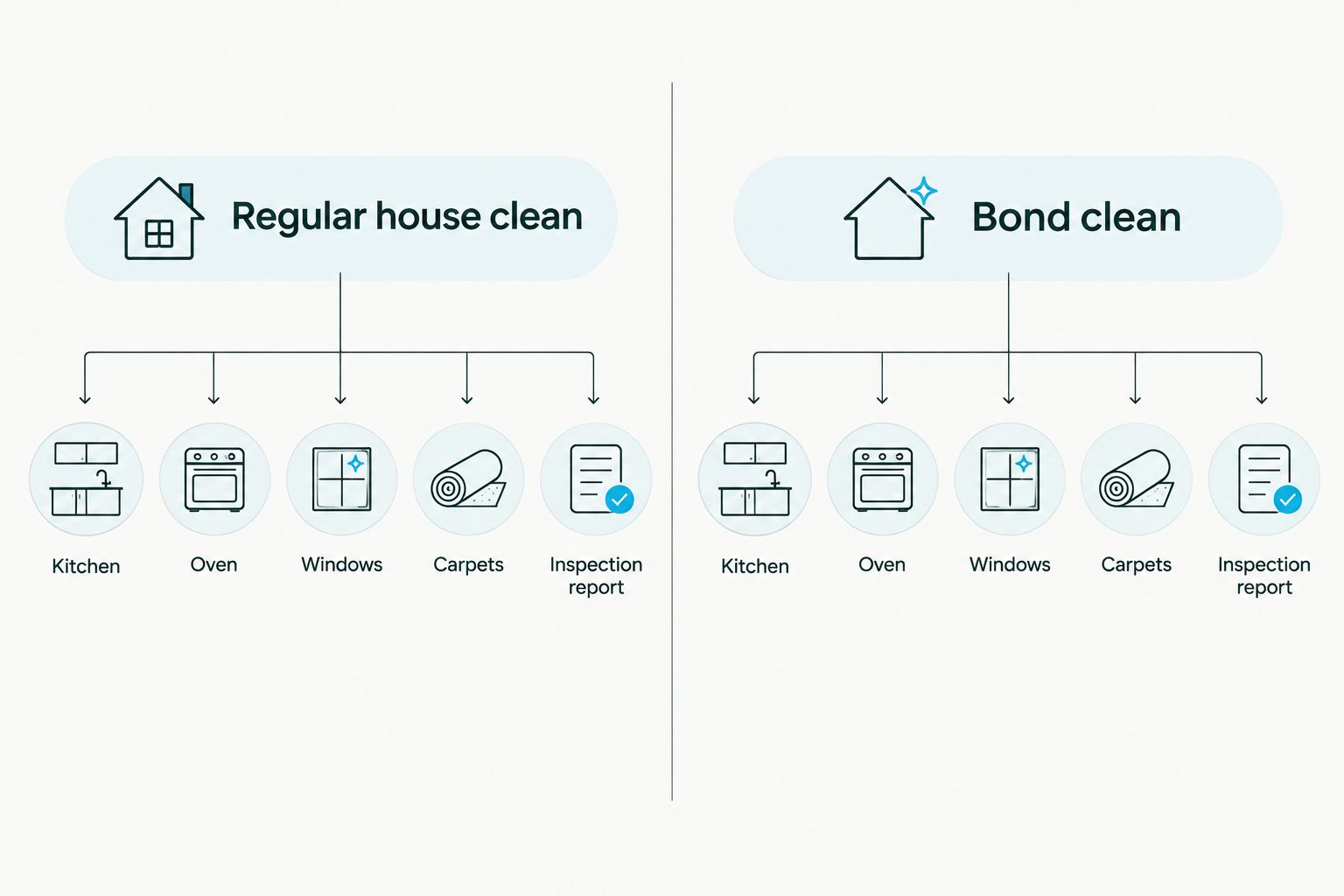
What a bond clean checks that a regular clean skips
A regular clean generally stops at what's visible from the doorway. A bond clean works through every fixed surface a property manager can physically inspect, including:
- Oven interiors and rangehood filters — grease residue is one of the most common inspection fail points
- Window tracks and flyscreens — dust and grit build up where a weekly wipe never reaches
- Exhaust fans — bathroom and kitchen fans collect grease and dust most tenants never open
- Skirting boards and light switches — checked for scuffs, not just dust
- Wardrobe interiors and cupboard shelving — inspected empty, not just wiped when in use
- Carpets — often require professional steam cleaning to remove stains and odours, not a household vacuum pass
Miss any one of these and the exit inspection can flag a partial fail even when the rest of the home presents well. Professional bond cleaning vs DIY breaks down which of these tasks tenants realistically manage themselves and which ones need equipment most households don't own.
Why bond clean standards vary
Not every bond clean needs the same depth of work. A handful of factors decide how much time and equipment a property needs at exit:
- Property type — apartments with fewer windows and no yard need less time than a freestanding house
- Length of tenancy — a five-year lease accumulates more grease, grime and wall marks than a twelve-month one
- Pets in the home — pet hair, odour and carpet staining add steam cleaning and odour treatment to the job
- Condition at move-in — the entry condition report sets the bar; older or already-worn fixtures still need to match that same report
- Agency checklist strictness — some property managers apply the standard entry report closely, others run stricter internal checklists
- Carpet and window coverage — homes with more soft furnishings and glazing simply have more surface area to clean
This is why two identical-looking three-bedroom houses can need noticeably different amounts of cleaning time to pass the same exit inspection.
“A bond clean is judged against a checklist, not against how the home feels when you walk in.”
Do I still need a regular clean before booking a bond clean?
Yes, doing a general tidy-up first — dishes away, rubbish out, furniture cleared — makes the bond clean faster and cheaper because the crew isn't spending time on basic housekeeping. It doesn't replace the bond clean itself; the two jobs cover different depths of work.
Can I do a bond clean myself instead of hiring a professional?
Yes, tenants can do their own bond clean, but the risk sits entirely with the tenant if the property manager flags something at inspection. A missed oven interior or a stained carpet found during re-inspection can mean a return trip, a delay on bond release, or a deduction — all things a professional bond clean with a re-clean guarantee is built to avoid.
What happens if the property fails inspection after a bond clean?
A failed inspection usually means the tenant gets a list of items to fix before the bond is released, sometimes with a re-inspection date attached. SparkleClean's 72-hour re-clean guarantee exists specifically for this scenario — if an inspection flags an item within that window, it gets addressed without the tenant booking and paying for a second clean from scratch.
Hiring a specialist for the exit clean, rather than reusing a regular house cleaner, is the one place in this whole comparison where the client's own service is genuinely the answer — not because a house cleaner can't clean, but because the checklist and the guarantee are built around the bond outcome specifically.
Book a bond clean, not a house clean
Checklist-based cleaning backed by a 72-hour re-clean guarantee.
FAQ
What's the difference between a bond clean and a regular house clean?
A bond clean targets the exact checklist a property manager inspects against at move-out, covering ovens, window tracks and skirting boards; a regular house clean just keeps a home liveable week to week.
Is a bond clean legally required at the end of a tenancy in Australia?
Tenancy agreements generally require the property returned in the same condition as the entry condition report, not a specific cleaning company or method — a bond clean is simply the practical way most tenants meet that standard in 2026.
Does a regular house cleaner do a bond clean?
Some do, but bond cleans need specific equipment for ovens, carpets and window tracks that a weekly house cleaning round doesn't typically carry — check the cleaner's checklist matches the exit inspection standard before booking.
How do I know if my bond clean meets inspection standard?
Compare the clean against the property's original entry condition report item by item; a bond clean that skips ovens, exhaust fans or window tracks is unlikely to hold up at re-inspection.
Is professional bond cleaning worth it over doing it myself?
Professional bond cleaning removes the risk of a failed inspection on tasks households commonly miss, like inside ovens and window tracks — DIY is legal but the tenant carries all the re-clean risk.
What happens if the property fails inspection after a bond clean?
The tenant typically gets a list of flagged items and a window to fix them before the bond is released — SparkleClean's 72-hour re-clean guarantee covers exactly this scenario.
Do I need carpet steam cleaning as part of a bond clean?
Most bond cleans include carpet steam cleaning because a vacuum pass alone won't remove ingrained stains or odour that a re-inspection can flag.
Can I use my regular house cleaner for a bond clean instead of a specialist?
Only if that cleaner explicitly works to a bond clean checklist; otherwise the job risks missing oven interiors, exhaust fans and window tracks that inspections specifically check.
One last thing
The single biggest reason tenants lose part of their bond in 2026 isn't a dirty-looking home — it's a clean-looking home with a dirty oven interior or grimy window tracks the property manager checks anyway. SparkleClean's reported 99% bond return rate on completed jobs comes from working the entry condition report as the checklist, not from cleaning harder in the rooms that already look fine.
If a tenancy is ending soon, what cleaning a tenant is responsible for at end of lease is worth reading before booking anything, so the scope of the job matches what the lease actually requires.
Related guides
- Bond cleaning checklist for apartments in Australia
- How to compare bond cleaning quotes from multiple companies
- What landlords check during a bond inspection in Australia
SparkleClean's end-of-lease service comes with a 72-hour re-clean guarantee. Get an instant price — no hidden fees, book in under 3 minutes.