
No — you cannot lose your bond for normal wear and tear in Australia. Landlords and agents can only make a bond deduction for damage that goes beyond fair use of the property, and every state's residential tenancies legislation draws that line in roughly the same place.
- Normal wear and tear cannot be deducted from your bond anywhere in Australia in 2026 — only damage beyond fair use qualifies.
- Faded paint, worn carpet pile and a few small nail holes are wear and tear, not damage — landlords can't charge for them.
- Burns, stains, broken fittings and large holes are damage, and a landlord can legally claim against your bond for these.
- A professional bond clean removes the cleaning argument entirely, but it won't erase a genuine damage claim.
Why this matters
The words "wear and tear" get thrown around loosely at bond inspections, and that's where tenants lose money they're legally entitled to keep. Agents sometimes list a scuffed skirting board or a slightly worn carpet path on a condition report as if it's chargeable damage — it isn't, and knowing the distinction is what stops a wrongful deduction before it happens.
The test used across Australian tenancy law is fair use over the length of the tenancy, not the property's original condition. If you're unsure what falls on your side of that line as a tenant, the breakdown of what cleaning tenants are responsible for at end of lease sets the baseline before you even get to the wear-and-tear question.
Can I lose my bond for normal wear and tear in Australia?
No. Every state and territory's residential tenancies legislation excludes fair wear and tear from what a landlord can charge against a bond. The dispute almost never comes down to the law — it comes down to which category a specific mark, stain or scuff falls into.
Here's how the same complaint gets treated differently depending on cause:
| Condition found at inspection | Example | Bond deduction allowed? |
|---|---|---|
| Worn carpet pile | Flattened traffic paths in hallways after 2+ years | No |
| Carpet burn or deep stain | Cigarette burn, spilled wine, red cordial | Yes |
| Faded paint | Lounge wall lightened by years of sun | No |
| Small picture hook holes | 2-3 small nail holes, filled or unfilled | No |
| Large wall damage | Fist-sized hole, multiple gouges | Yes |
| Light scuffs on skirting | Marks from furniture moved during the tenancy | No |
| Broken fitting | Snapped tap handle, cracked light switch | Yes |
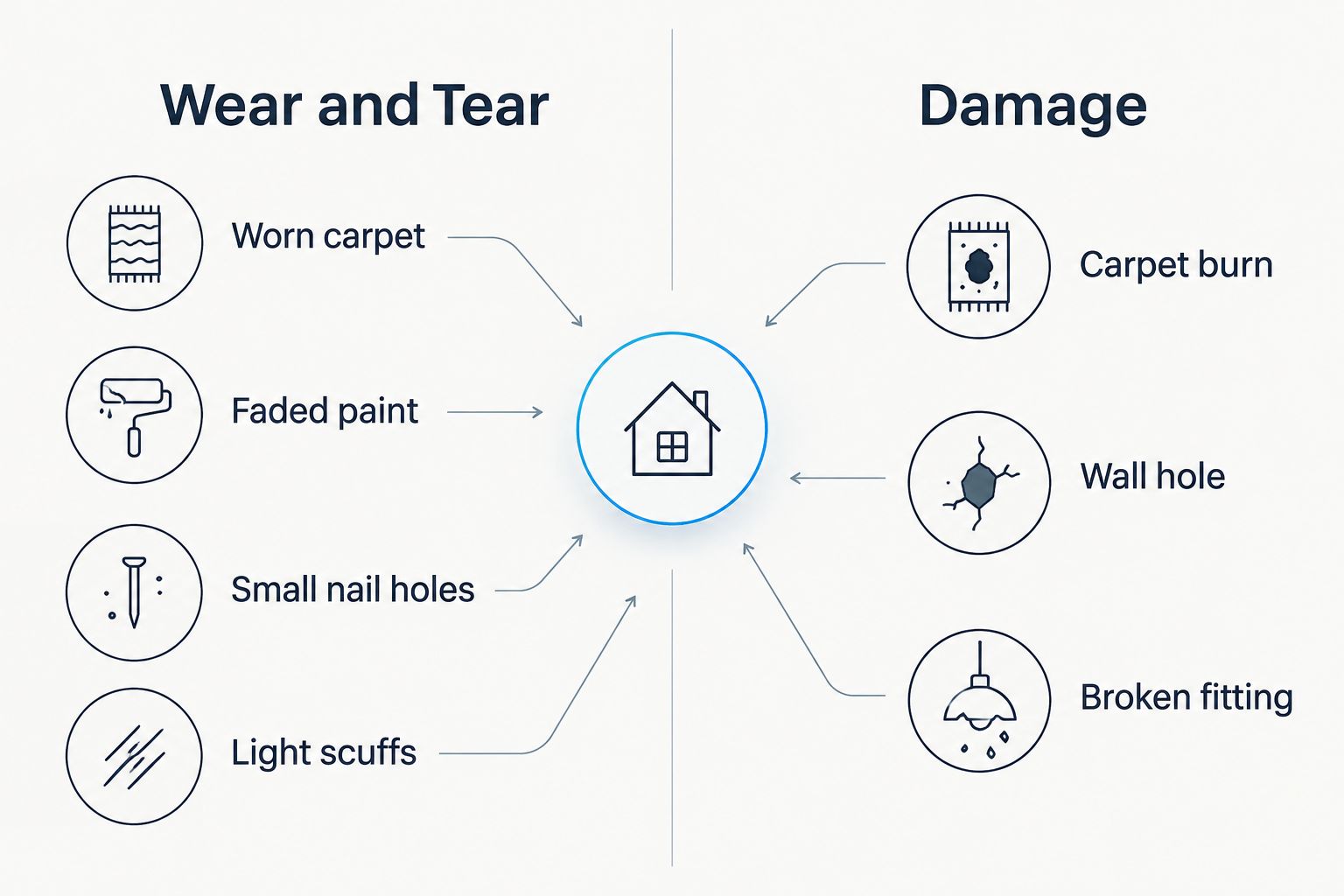
What counts as normal wear and tear
- Carpet pile flattened by foot traffic in high-use areas
- Paint or wallpaper fading from sunlight over the tenancy
- Small nail or picture hook holes, filled or left as-is
- Loose door hinges or handles from years of normal opening and closing
- Minor scuffs on walls and skirting boards from furniture movement
- Grout discolouration from age rather than neglect
What counts as damage a landlord can charge for
- Carpet burns, deep stains, or pet damage beyond normal shedding
- Holes larger than a picture hook, or multiple holes in one wall
- Broken fittings, cracked tiles, or snapped blinds and curtain rods
- Mould caused by tenant neglect rather than a building defect
- Stains or scorch marks on benchtops, ovens, or cabinetry
- Missing or damaged items listed on the original condition report
Why wear-and-tear disputes happen
Most disputes trace back to a handful of repeat causes, not genuinely ambiguous damage:
- No entry condition report, or a poor-quality one, leaves nothing to compare the exit report against
- Longer tenancies naturally show more wear, and some agents treat that as chargeable regardless of cause
- Cleaning and damage get conflated on the same line item, making a fair charge look inflated
- Photos at exit but not at entry, so there's no baseline to prove the mark existed before you moved in
- Agent inexperience with what how much bond a landlord can legally withhold for cleaning actually covers under tenancy law
- Tenants not disputing on the spot, which lets a wrongful deduction go through unchallenged
“Fair wear and tear is the tenant's legal right in Australia, not something a landlord grants at their discretion.”
A bond clean doesn't argue your wear-and-tear case for you, but it removes the one variable landlords use most often to blur the line: dirt disguised as damage. SparkleClean's end-of-lease cleans are backed by a 72-hour re-clean guarantee, which matters specifically because it takes cleanliness off the table before the inspection even starts.
Book your bond clean before inspection day
Cover the cleaning side so any dispute is purely about wear and tear.
What do landlords check during a bond inspection?
Landlords and agents work through a condition report line by line, checking the property against its state at the start of the tenancy — not against how it looked new. The detailed breakdown of what landlords check during a bond inspection covers the room-by-room standard most agents actually use in 2026.
Does a professional bond clean protect against wear-and-tear disputes?
A professional clean protects you against cleaning-based deductions, not wear-and-tear claims — the two are legally separate issues. SparkleClean's bond cleaning removes grease, grime and residue disputes so an agent can't fold a cleanliness complaint into a damage claim, which is a common tactic when the two get mixed together on one line item.
How much bond can a landlord withhold for cleaning?
A landlord can only withhold enough to bring the property back to the cleanliness standard it was at when you moved in — not to a brand-new standard. If a claim exceeds that, it's worth checking the specific limits before you agree to any deduction.
FAQ
Can I lose my bond for normal wear and tear in Australia?
No, you can't lose your bond for normal wear and tear in Australia in 2026 — tenancy law in every state excludes fair wear and tear from bond deductions. Landlords can only claim for damage beyond ordinary use.
What's the difference between wear and tear and damage?
Wear and tear is gradual change from normal living — faded paint, worn carpet, small nail holes. Damage is harm beyond fair use — burns, stains, holes, or broken fittings — and only damage can be charged against a bond.
Can a landlord charge for a worn carpet at the end of a lease?
A landlord can't charge for carpet that's simply worn from normal foot traffic over a long tenancy. They can charge for burns, stains, or damage that goes beyond fair use.
Do I need to repaint before moving out because of faded walls?
No, faded paint from sunlight over the tenancy is normal wear and tear, and a landlord can't require repainting or deduct your bond for it. Repainting is only chargeable if you caused actual damage, like unapproved holes or marks.
Is a small nail hole from a picture frame classed as damage?
A small nail hole is generally treated as wear and tear, not damage, especially when there are only one or two. Multiple large holes or gouges in a wall move into chargeable damage territory.
Can dirty carpets cost me my bond even if there's no damage?
Yes, dirty carpets can cost part of your bond even without physical damage, because cleanliness is judged separately from wear and tear. A professional carpet clean before inspection removes that risk entirely.
What should I do if a landlord tries to charge me for wear and tear?
Dispute it directly with the agent first, citing that the item is fair wear and tear under your state's tenancy law. If that doesn't resolve it, lodge a formal bond dispute with your state's tenancy authority.
One last thing
The strongest evidence in any wear-and-tear dispute isn't an argument — it's your entry condition report and move-in photos. Renters who photograph every room the day they get the keys in 2026 win far more disputes than those who rely on memory or the agent's word at the final inspection, simply because the comparison point already exists in writing.
Related guides
- What happens if you fail a bond inspection in Australia
- How to dispute a bond deduction in Australia
SparkleClean's end-of-lease service comes with a 72-hour re-clean guarantee. Get an instant price — no hidden fees, book in under 3 minutes.