
Yes, you can clean carpets yourself instead of paying for professional steam cleaning at the end of a lease in 2026. The result must meet your lease obligations and restore the carpet to its entry condition, allowing for fair wear and tear. DIY is a poor choice when the carpet has persistent stains, pet odour, excess moisture or a documented professional-cleaning requirement.
- DIY carpet cleaning works when the lease permits it and the finished carpet matches its entry condition.
- Check the lease, entry condition report and your state tenancy authority before cleaning in 2026.
- Allow up to 24 hours for drying and keep a 48-hour buffer before the final inspection.
- Sparkleclean end-of-lease carpet cleaning suits renters who need professional cleaning and written proof of completion.
Why this matters
Your property manager assesses the finished carpet, not the effort you put into cleaning it. The professional bond cleaning versus DIY comparison comes down to risk: DIY gives you control but no professional invoice, while a paid service costs more and reduces the work you must complete yourself.
Australian residential tenancy rules differ by state and territory. Do not rely on a general claim that every renter must pay for professional carpet cleaning. Check the wording in your lease, the entry condition report and current 2026 guidance from your state or territory tenancy authority.
The inspection also happens after the carpet dries. A surface that looks even while damp can show water marks, remaining stains or flattened traffic lanes later. Your cleaning plan needs enough time for drying, inspection and a second attempt before the keys are returned.
Can I clean carpets myself instead of steam cleaning?
Yes, if DIY cleaning is compatible with the carpet, satisfies your tenancy obligations and produces an inspection-ready result. Vacuuming alone is not a substitute for extraction when the carpet contains embedded soil, visible spills or odour.
| Decision factor | DIY carpet cleaning | Professional steam cleaning |
|---|---|---|
| Best for | Lightly soiled carpet, flexible timing and no requirement for professional proof | Stained carpet, pet-related soil, short deadlines or requests for an invoice |
| Main advantage | You control the timing and do the work yourself | Equipment, treatment and extraction are handled for you |
| Main disadvantage | Greater risk of overwetting, uneven extraction and missed stains | Higher upfront cost and a booking must be arranged |
| Proof of work | Photos, machine-hire records and cleaning-product receipts | Service invoice or receipt |
| Drying responsibility | You manage ventilation and confirm the carpet is dry | You still need to follow access and drying instructions |
| Final verdict | Try it when the carpet is lightly soiled and your documents permit DIY. | Book it when the inspection risk is higher than the saving. |
Neither option guarantees a bond outcome. The agent can still identify unrelated damage, and professional cleaning cannot reverse permanent wear, bleaching, burns or damaged fibres. The practical goal is to remove removable soil without creating a new problem.
How to clean end-of-lease carpets yourself
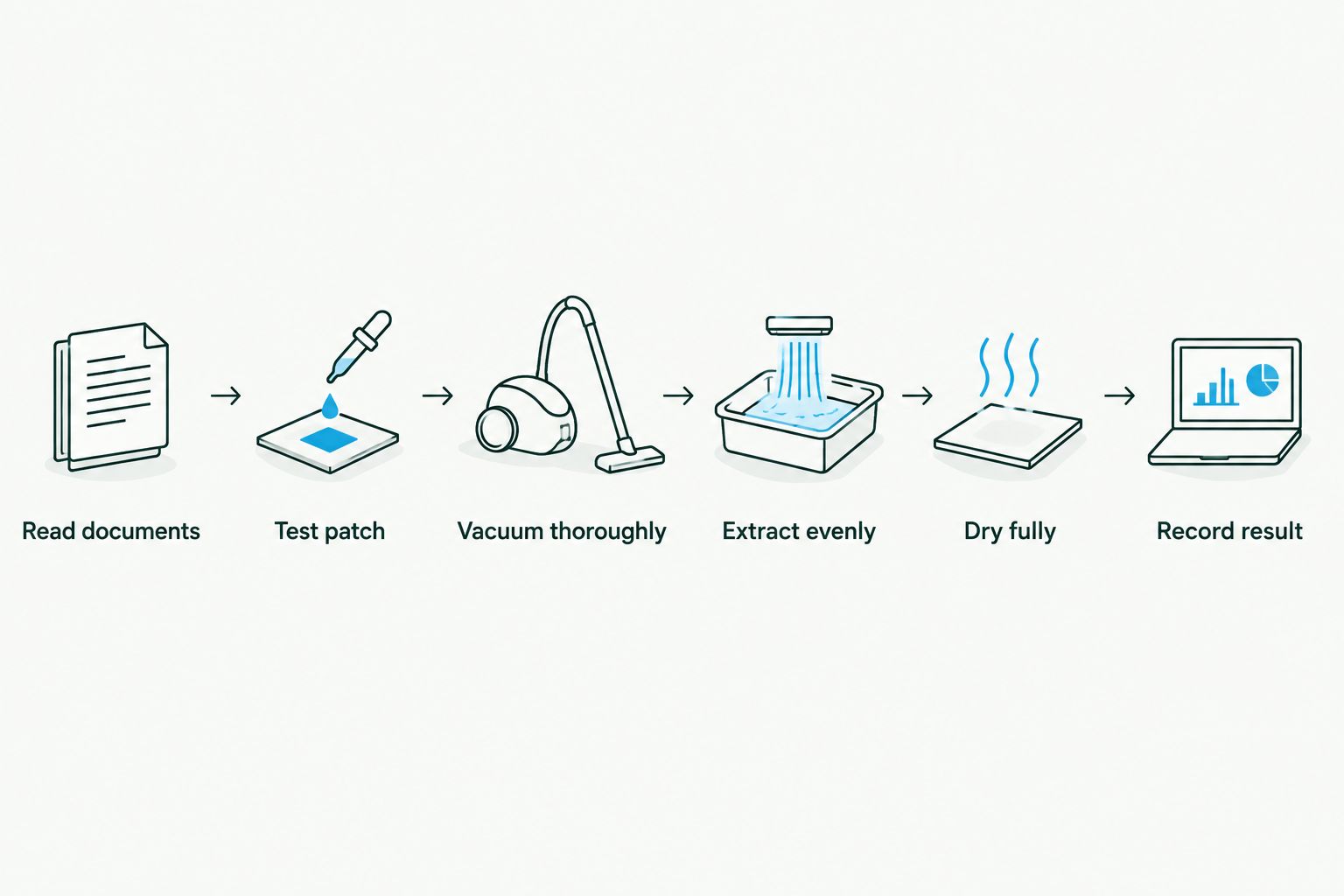
Follow a controlled process rather than hiring a machine and starting in the largest room. Each step protects either the carpet, your evidence or the inspection timeline.
- Read the lease and entry report. Look for carpet-cleaning terms and notes about the carpet's original condition. Compare those documents with current 2026 guidance from the relevant tenancy authority.
- Identify the carpet material. Check any care label or property information available to you. If you cannot confirm that wet extraction is suitable, ask the property manager or use a qualified carpet cleaner.
- Test a 1-square-metre patch. Choose an inconspicuous area and use the intended solution at the labelled dilution. Stop if colour transfers, the pile changes or the backing reacts poorly.
- Vacuum thoroughly. Remove loose soil before adding moisture. Pay particular attention to edges, doorways and established traffic paths.
- Treat spots individually. Blot spills instead of rubbing them across the fibres. Follow the stain-treatment label and do not mix cleaning chemicals.
- Extract in even passes. Follow the machine manufacturer's operating instructions. Avoid repeated wet passes that leave the carpet saturated.
- Ventilate the property. Use safe airflow and follow the equipment instructions. Allow up to 24 hours before deciding that the carpet is fully dry.
- Recheck after 12 hours. Inspect for returning stains, damp areas, odour and uneven lines. Leave a 48-hour buffer before the final inspection so there is time to correct a poor result.
- Record the finished condition. Take clear photos from several positions after the carpet is dry. Keep relevant receipts and the machine-hire agreement with your exit records.
Do not add extra detergent because the carpet looks dirty. Residue can attract soil and make fibres feel stiff, while too much water can extend drying. Use only products approved for the machine and carpet type.
A DIY attempt should have a stop point. If staining returns, odour remains after drying or the machine is not recovering enough water, stop adding moisture and arrange professional treatment.
When professional steam cleaning is the safer choice
Professional carpet cleaning is the safer option when one or more of these conditions applies:
- The lease and entry records support a professional-cleaning requirement.
- Your property manager has asked for an invoice, and you need to clarify whether that request is enforceable.
- The carpet contains pet-related soil or persistent odour.
- Several rooms have visible traffic lanes or set-in stains.
- You cannot provide enough ventilation or drying time.
- The final inspection is too close to allow a second DIY attempt.
- You do not know whether the carpet can tolerate the planned treatment.
The disadvantage is the additional cost and the need to coordinate access. You also need to confirm what is included, because general end-of-lease cleaning and carpet steam cleaning are not automatically the same service. The guide to whether carpet steam cleaning is included in a standard bond clean explains that distinction.
Sparkleclean professional carpet steam cleaning is best for Australian tenants who want the carpet handled as part of an inspection-focused end-of-lease clean. It is not the automatic answer for every tenancy; a lightly soiled carpet with no professional-cleaning requirement can still be a reasonable DIY job.
Sparkleclean provides end-of-lease cleaning that can include carpet steam cleaning alongside other vacate-clean tasks. Confirm the required scope before booking so the service matches the property and the final inspection.
Arrange your end-of-lease clean
Confirm the carpet-cleaning scope before your final inspection.
Why the result varies
- Lease and entry evidence: A generic clause does not tell the full story. The lease, entry condition report and applicable tenancy rules must be read together in 2026.
- Carpet condition: Light surface soil is easier to address than old stains, odour, discolouration or damaged fibres. Cleaning removes soil; it does not repair physical damage.
- Carpet construction: Fibres, backing and installation methods respond differently to moisture and cleaning products. The care instructions take priority over a generic online method.
- Machine extraction: A machine that leaves too much water behind increases drying time and the chance of an uneven finish. Technique matters as much as applying solution.
- Stain type: One treatment does not suit every spill. Using the wrong product can spread the mark, set it or affect the carpet colour.
- Ventilation and humidity: Air movement affects drying. A closed property needs more planning than an empty home with safe cross-ventilation.
- Inspection timing: A 48-hour buffer gives you time to inspect dry carpet and respond. Cleaning immediately before handing back the keys removes that option.
The key distinction is removable soil versus permanent change. A dark traffic lane can be soil, worn fibres or both. If repeated cleaning does not improve it, more moisture is unlikely to solve the problem.
Can an agent require a professional carpet-cleaning receipt?
An agent can ask for a receipt, but whether you must provide one depends on the lease, the carpet's recorded entry condition and the tenancy rules applying where you live. Request the requirement in writing and compare it with official 2026 guidance before agreeing to an unsupported charge.
A receipt proves that a service occurred; it does not prove that every stain was removable or that the carpet has no damage. Keep the invoice with dated exit photos and your condition report rather than relying on one document alone.
Is vacuuming enough for an end-of-lease carpet clean?
Vacuuming is enough only when it restores the carpet to the required condition and no deeper treatment is needed. It removes loose dry soil but does not extract spills, sticky residue or embedded contamination.
Inspect doorways, paths between rooms and areas where furniture stood. These spots often reveal differences that are easy to miss when the room is still furnished.
Can I use a hired carpet cleaner for a bond clean?
Yes, you can use a hired carpet cleaner when the equipment and cleaning solution are suitable for the carpet. Follow the manufacturer's directions, complete a test patch and retain the hire record as part of your evidence.
Hiring a machine does not make the result professional. Your property manager will assess the carpet after it dries, so technique, extraction and timing still determine whether DIY was the right decision.
Should I try DIY cleaning before booking a professional?
Try DIY first only when you have enough time to let the carpet dry and arrange another solution if it fails. A 48-hour inspection buffer is more useful than cleaning late and hoping damp carpet passes.
Skip the trial run when the carpet has strong odour, extensive staining or uncertain colourfastness. Repeated treatment can make professional correction harder without improving the inspection result.
FAQ
Can I clean carpets myself instead of steam cleaning professionally?
Yes, you can clean carpets yourself if DIY cleaning satisfies your lease obligations and restores the carpet to its entry condition, allowing for fair wear and tear. Check the applicable tenancy rules before deciding.
Do I need professional carpet cleaning at the end of my lease in 2026?
Not every Australian tenancy requires professional carpet cleaning in 2026. The answer depends on your state or territory rules, lease terms and the carpet's documented entry condition.
How long should I leave carpet to dry before the final inspection?
Allow up to 24 hours for the carpet to dry and keep a 48-hour buffer before inspection. Drying time changes with ventilation, humidity, carpet construction and the amount of water extracted.
Will a hired carpet cleaner remove every stain?
No, a hired carpet cleaner will not remove every stain. Permanent colour change, fibre damage and some set-in marks can remain even after correct cleaning.
What proof should I keep after DIY carpet cleaning?
Keep dated photos of the dry carpet, the machine-hire record and receipts for cleaning products. Retain these with your entry and exit condition records.
Is professional carpet cleaning better for pet odour?
Professional carpet cleaning is the safer choice for persistent pet odour because the affected areas can be assessed and treated before extraction. Cleaning still cannot guarantee removal where contamination has reached the carpet backing or subfloor.
When should I choose Sparkleclean for carpet steam cleaning?
Choose Sparkleclean when you need end-of-lease carpet steam cleaning coordinated with the broader vacate clean. Confirm the required rooms and inspection date before booking.
One last thing
Judge the carpet only when it is dry. Before returning the keys in 2026, view each room from the doorway and across the window light, then press a clean white towel onto a test area for 30 seconds. New colour, moisture or residue on the towel means the carpet needs more drying or further assessment.
This final check catches problems hidden by damp fibres. It also gives you time to decide whether another DIY pass is sensible or whether professional help is now the lower-risk option.
Related guides
- How to clean carpets for end of lease in Australia
- How to remove carpet stains before end of lease
- Can a landlord require professional cleaning?
SparkleClean's end-of-lease service comes with a 72-hour re-clean guarantee. Get an instant price — no hidden fees, book in under 3 minutes.